Client portals give your clients one branded, secure place to see their projects, upload files, sign contracts, and pay invoices, instead of chasing all of that across email threads and shared drives. If you’re looking for the best client portal software to replace that mess, the fix is the same: one branded login instead of five scattered threads, which improves customer experience without adding headcount and adapts to different business needs as your client roster grows.
The right pick depends less on a feature checklist and more on how your business actually operates: a productized service shop, a subscription business, a project-based creative studio, and a regulated professional practice all need genuinely different things from a portal.
Below, we compare 14 client portals on pricing, features, and honest pros and cons, so you can match the client portal to your business model rather than the other way around. This is our pick for the best client portals for 2026, built to compare customer and client portal software side by side rather than treat them as one category.
Key Takeaways
- Client portal software centralizes files, messaging, contracts, and payments in one branded space for your clients, replacing scattered email and drive links.
- Pricing ranges from genuinely free (Zendo, Assembly, Notion, Softr’s entry tier) to $500+/month for enterprise workflow tools like Moxo.
- The best pick depends on your business model: productized/subscription businesses, project-based freelancers, no-code builders, and regulated professional services each have a clear front-runner on this list.
- A comparison table follows the “what is a client portal” section so you can shortlist client portals before reading full reviews.
How we picked these client portals. We included Zendo in this list because it’s our own product and it’s built specifically for the productized-service use case this article covers; we’ve disclosed that plainly rather than burying it, and we’ve held it to the same pricing, feature, and G2-rating scrutiny as every other client portal here.
We selected the other 13 client portals for real market presence (verifiable G2 review volume, active pricing pages, and genuine feature differentiation) and to cover the distinct business models service businesses actually run: productized/subscription, all-in-one business management, creative freelance, no-code/custom-build, and regulated/compliance-heavy practices. Pricing and G2 ratings below were checked as of this update; this category’s pricing shifts often, so verify current numbers on the vendor’s site before you buy.
What Is Client Portal Software?
Client portal software is a secure, branded online space where a business and its clients share files, messages, contracts, invoices, and project updates in one place instead of scattered across email, spreadsheets, and shared drives. Rather than digging through their inbox for the latest invoice or contract version, a client can log into one dashboard that shows exactly where things stand.
“Client portal software” and “customer portal software” get used interchangeably, and so do “client service portal” and “customer service portal,” but they usually describe different jobs.
- A client portal is typically built around an ongoing service relationship: a specific client with a name, a project history, files, and an invoice trail.
- A customer portal, on the other hand, is usually a self-service layer for a larger customer base: order history, support tickets, knowledge base articles, account settings.
The client portals in this list lean toward the client-relationship side of that line: agencies, freelancers, and service businesses managing a defined roster of paying clients, not a self-service support hub for thousands of anonymous customers.
For most service businesses, the practical benefits are concrete:
- fewer “can you resend that file” emails,
- a paper trail for contracts and payments,
- and a more professional first impression than a Google Drive link pasted into an email.
Some teams organize their work by client or project, others by service line, and whichever axis your team already thinks in shapes what a good client portal provides day to day, since a different client will expect a different structure than a different project would.
Key Features to Look For in a Client Portal
The benefits of client portal software show up fast once you stop chasing files over email, but not every tool ships the same portal features. Not every client portal needs every feature below, but these are the categories worth checking before you commit to a plan.
- Branding and white-label options. Can you put your own logo, colors, and domain on the portal, or will it look like a third-party tool bolted onto your service? A portal with your company’s logo front and center builds more trust than a generic dashboard, which is exactly what a branded portal should do. A white-label client portal matters most for agencies where the client relationship, not the software vendor, needs to be front and center.
- File sharing and security. Look for version control, permission settings, and, for regulated industries, certifications like ISO 27001 or SOC 2. A secure client portal isn’t optional if you’re handling contracts, financial documents, or health information; secure client portal software should be non-negotiable, not an upsell.
- Integrations. Check whether the portal connects to the accounting, CRM, and calendar tools you already use, since a portal that lives in isolation from your other systems creates more manual work, not less. If you already run separate management software for accounting or scheduling, look for management tools that integrate rather than duplicate them, and check what client access controls look like down to a single shared file.
- Payments and invoicing. Some client portals charge a transaction fee on top of your subscription; others don’t. That difference adds up fast if you’re processing meaningful payment volume through the portal. A few vendors here offer a free plan good enough to run a real client relationship on instead of a demo sandbox.
- Messaging. In-portal messaging keeps client communication tied to the relevant project or file instead of buried in a general inbox. A portal that logs client interactions in one place doubles as a lightweight client hub even when that’s not its primary job, so try to use the portal yourself the way a client would before you commit.
- Mobile access. Clients increasingly expect to check status or approve something from a phone, so a usable mobile experience (app or responsive web) matters more than it used to. Not every portal solution needs a dedicated app; some businesses are genuinely better served by a lightweight client portal solution built on a tool they already use, like Notion or Airtable via Softr.
Ultimately, you want a portal that allows clients to self-serve on the basics so you’re not the bottleneck for every small update; if you use a client portal for the first time this year, start by listing the three tasks eating the most of your week over email.
Client Portal Software Comparison at a Glance
The table below lines up starting price and G2 rating for all 14 client portals so you can shortlist before reading the full write-ups. A few of these lean more toward project management than a dedicated portal, so match the category to what you actually need before comparing prices line by line.
“Starting price” reflects each vendor’s lowest published tier as of this update; several vendors changed pricing structures within the past year, so double-check before you buy. If budget is the deciding factor, several client portals here (Zendo, Assembly, Notion, Softr) have a genuinely usable free client portal software tier, not just a time-limited trial.
| Tool | Best For | Starting Price | G2 Rating |
|---|---|---|---|
| Zendo | Productized & subscription service businesses | Free tier; paid from $25/mo (annual) | 4.9/5 (11 reviews) |
| SuiteDash | All-in-one business management | $19/mo (annual) | 4.8/5 (595 reviews) |
| HoneyBook | Creative freelancers | $29/mo (annual) | 4.4/5 (194 reviews) |
| Bonsai | Contracts and freelance payments | $9/mo (annual) | 4.3/5 (102 reviews) |
| FuseBase | All-in-one workspace + client collaboration | Free tier; paid from ~$32/mo | 4.7/5 (106 reviews) |
| Clinked | Secure file sharing | ~$119/mo | 4.8/5 (152 reviews) |
| Moxo | Enterprise workflow automation | $500/mo | 4.5/5 (194 reviews) |
| Client Portal (WordPress) | WordPress-native agencies | $199/yr | N/A |
| Assembly | Branded client experiences | $0/mo | 4.7/5 (~300 reviews) |
| Zoho Creator | Custom portal development | $8/user/mo (annual) | 4.3/5 (164 reviews) |
| Softr | No-code portal builder | Free tier; paid from $49/mo | 4.7/5 (711 reviews) |
| MyDocSafe | Secure document workflows | ~$9.90/user/mo | 3.9/5 (16 reviews) |
| Notion | Budget/DIY option | $0/mo | 4.6/5 (13,000+ reviews) |
| TaxDome | Accounting & bookkeeping firms | ~$800/user/yr | 4.7/5 (3,500+ reviews) |
The 14 Best Client Portal Software Picks
1. Zendo: Best for Productized and Subscription Service Businesses
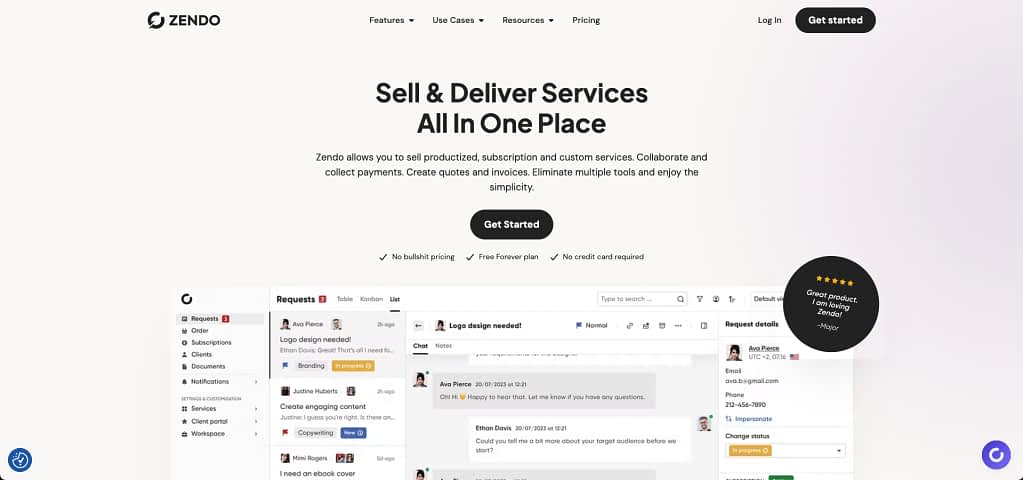
Zendo is a client portal and service-delivery platform built for businesses that sell fixed-scope packages, like a logo design, a monthly content package, or a set number of SEO audits, rather than custom, hourly-billed projects. This is our own product, disclosed plainly: it’s on this list because it’s genuinely built for the productized services and subscription business model this article keeps coming back to, and it’s been independently ranked by at least one third-party review site (The Digital Project Manager) as a top pick specifically for productized service businesses, which is external validation beyond our own claim.
Prices:
- Essential $0/mo (3 clients, 1 published service, 1 user)
- Core $25/mo
- Pro $49/mo
- Agency $79/mo, billed annually, with $0 transaction fees on every plan, including the free one.
Key features:
- Branded client portal for project status, files, and messages
- Built-in service catalog/storefront clients can browse and buy from directly
- Invoicing with $0 transaction fees on all tiers
- Client onboarding forms to collect project details upfront
- File sharing between you and clients
✅ Advantages of Zendo
- $0 transaction fees at every tier, including the free plan, which is unusual in a category where most competitors take a cut of processed payments
- A real free plan (not just a trial) that includes a working storefront and portal
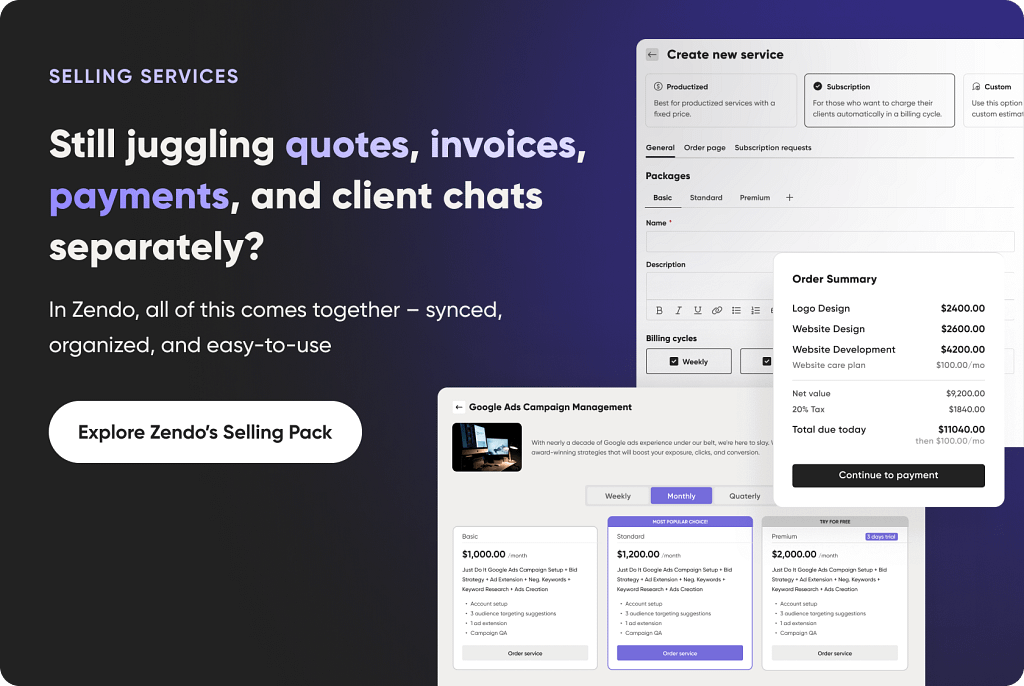
- Combines portal, service catalog, and invoicing in one product built around the productized/subscription model specifically
⚠️ Disadvantages of Zendo
- Smaller G2 review base (11 reviews) than most established competitors on this list, so there’s less third-party volume to judge consistency at scale
- The free tier caps out at 3 clients and 1 published service, which limits how far you can stress-test it before upgrading
“Zendo has provided me with a complete back-office solution for my Productised Service business. I can now launch a service and onboard a customer within minutes. Zendo provides my business with a centralised location for all client communication, which is incredibly handy. The Zendo support team are responsive, and should any issues arise, I can let them know and receive updates as soon as possible. Pricing is incredibly accessible for any business size.”
(Xavier D, G2)
2. SuiteDash: Best All-in-One for Business Management
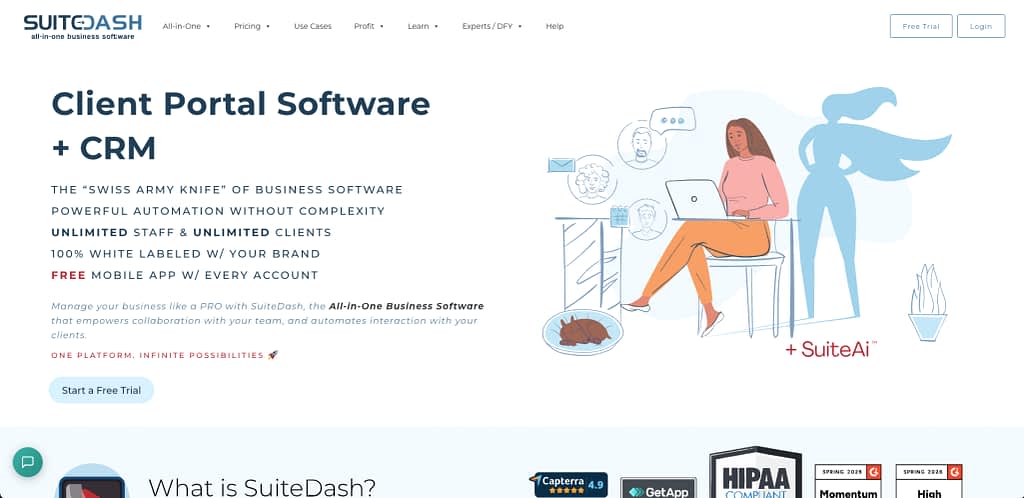
SuiteDash bundles a client portal into a broader CRM and business-management suite, aimed at agencies and consultants who want one flat-priced system instead of stitching together separate tools for CRM, invoicing, and client-facing work.
Prices:
- Start $19/mo
- Thrive $49/mo
- Pinnacle $99/mo, flat pricing (not per user).
Key features:
- Unlimited CRM contacts, staff accounts, and client portals on every tier
- White-label branding, including a custom-branded mobile app
- Proposals and automation workflows
- Built-in LMS (learning management system) for onboarding content
- 100GB to 2TB of storage depending on tier
✅ Advantages of SuiteDash
- Unlimited users and client portals at one flat price, which is rare in this category and can be significantly cheaper than per-user pricing as a team grows
- Full white-labeling, down to a branded mobile app, at every paid tier
- Genuinely broad feature set, so it can replace several separate tools
⚠️ Disadvantages of SuiteDash
- The breadth of features means a real learning curve during setup
- Flat pricing is generous for larger teams but can feel like paying for more than you need if you’re a solo operator
“As a solo professional, I wanted to look more organized and “bigger” than a one‑person shop, and SuiteDash really helps with that. Clients get a branded portal where they can see their messages, files, invoices, and projects, which creates a very polished experience. Having CRM, proposals, contracts, tasks, and billing under one roof has reduced the number of separate tools I juggle, and the built‑in automation is surprisingly strong for the price.”
(Wiyao A, G2)
3. HoneyBook: Best for Creative Freelancers
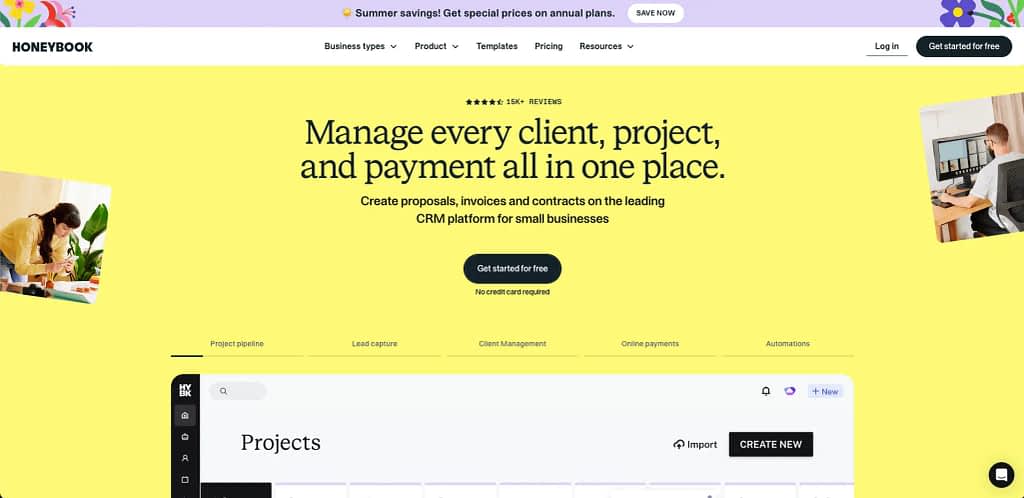
HoneyBook is built around the proposal-to-payment pipeline that creative freelancers (photographers, designers, event planners) run constantly: send a proposal, get it signed, invoice, get paid, all inside one client-facing flow.
Prices:
- Starter $29/mo (annual) or $36/mo (monthly)
- Essentials $49/mo (annual) or $59/mo (monthly)
- Premium $109/mo (annual) or $129/mo (monthly), plus card processing fees starting around 2.7% + 10¢ per transaction.
Key features:
- Contracts and e-signature
- Invoicing and payments
- Proposal templates built for creative service pitches
- Scheduling and workflow automations
- HoneyBook AI for drafting client communication
- QuickBooks sync on Essentials and above
✅ Advantages of HoneyBook
- The proposal-to-contract-to-payment flow is genuinely streamlined for one-off creative projects
- Strong brand recognition among photographers, designers, and event professionals specifically
- Scheduling and automations reduce a lot of manual back-and-forth on client bookings
⚠️ Disadvantages of HoneyBook
- Card processing fees are separate from the subscription and add up on higher payment volume
- Less suited to ongoing subscription or productized service relationships than one-off project work
“Easy to use, short learning curve and setting up and customizing templates to get started was easy, and have further refined since then.. Online help has been useful too. Integrates many things I was doing over multiple separate tools (contracts, invoices, calendar booking and now galleries). AI tools are great for automations and template driven responses. Pricing is very affordable for a start up one person business. Never had issues with downtime or unresponsiveness.”
(Graeme R, G2)
4. Bonsai: Best for Contracts and Freelance Payments
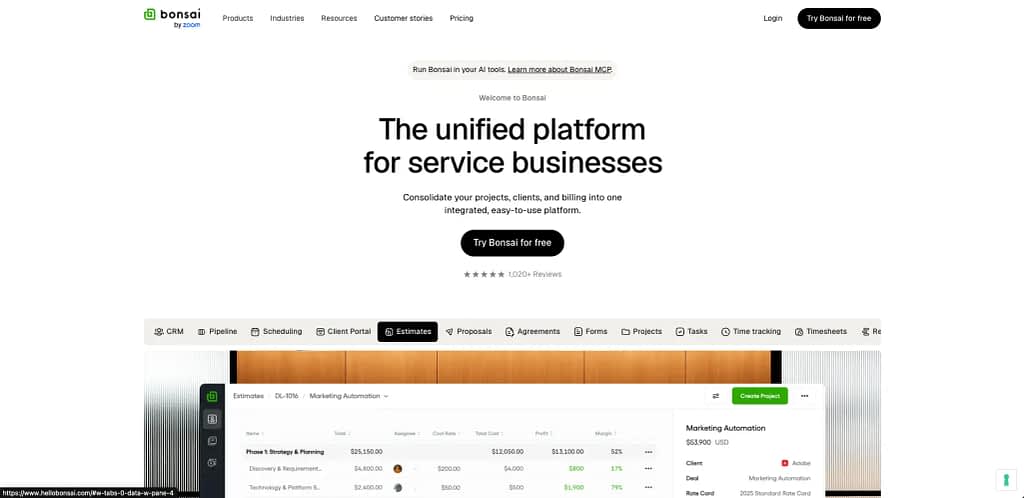
Bonsai leans hardest into contracts, invoicing, and getting freelancers paid on time, with the client portal functioning as one piece of a broader freelance back-office toolkit rather than the headline feature.
Prices:
- Basic $9/mo (annual) or $15/mo (monthly)
- Essentials $19/mo (annual) or $25/mo (monthly), the entry tier that includes the client portal alongside invoicing and contracts
- Premium $29/mo (annual) or $39/mo (monthly)
- Elite $49/mo (annual) or $59/mo (monthly), with a 3-user minimum, priced per user
Key features:
- Contracts and e-signature
- Invoicing with online payment collection
- Time tracking for billable work
- Proposals and lightweight CRM
- Expense tracking
- Client portal, available from the Essentials tier up
✅ Advantages of Bonsai
- Invoicing is a genuine strength, scoring 9.6 on G2’s own feature breakdown, so it’s a solid pick if getting paid reliably is the top priority
- Low entry price point makes it accessible for solo freelancers just starting out
- Combines several freelance back-office tools (contracts, time tracking, expenses) that would otherwise require separate subscriptions
⚠️ Disadvantages of Bonsai
- The client portal itself is a secondary feature bolted onto a broader freelance toolkit, not the primary design focus
- Elite tier’s 3-user minimum makes per-seat costs less predictable for growing teams
“It’s incredible to send contracts, proposals, invoices, and forms to clients all in the same platform. I love that Bonsai is a one-stop shop for freelancers and small businesses. I use Bonsai almost every day for my business. Their support team is very helpful and quick to respond to any issues I may have encountered.”
(Chelise B, G2)
5. FuseBase: Best for All-in-One Workspace and Client Collaboration
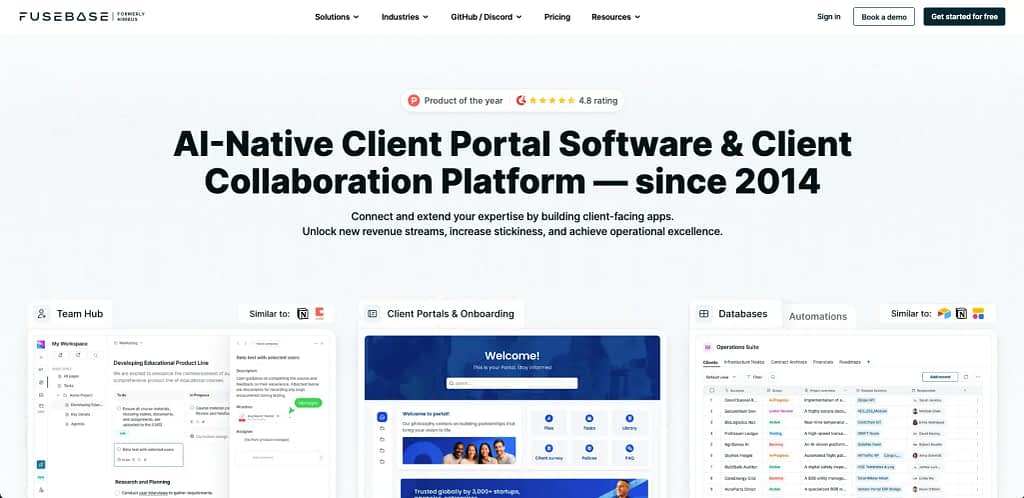
FuseBase (formerly Nimbus) combines client portal and workspace features with an internal knowledge base, collaborative docs, and AI agents, positioning itself less as a single-purpose client portal solution and more as a shared workspace where client collaboration and internal documentation live side by side.
Prices:
- Solo $32/mo
- Essentials $82/mo
- Advanced $266/mo
- Enterprise custom pricing
Key features:
- Branded client portals
- AI agents/copilot built into the workspace
- Knowledge base and wiki functionality
- Collaborative document editing
- Automation runs for repeatable workflows
- White-label branding, available from the Advanced tier up
✅ Advantages of FuseBase
- Combines a client-facing portal with internal knowledge management in one product, which cuts down on tool-switching
- Built-in AI agents are a genuine differentiator versus most portal-only competitors
- Free tier is usable enough to evaluate the core workspace before committing
⚠️ Disadvantages of FuseBase
- Published pricing is inconsistent across sources, so getting an exact quote may require talking to sales
- White-label branding is locked behind the higher Advanced tier, not available at entry-level pricing
“My team has a dedicated internal space with PM tools and a document editor, and our clients have a personalized portal with an AI assistant. FuseBase handles data seamlessly, allowing our sales and onboarding teams to focus more on building relationships than dealing with administrative tasks.”
(Iryna F, G2)
6. Clinked: Best for Secure File Sharing
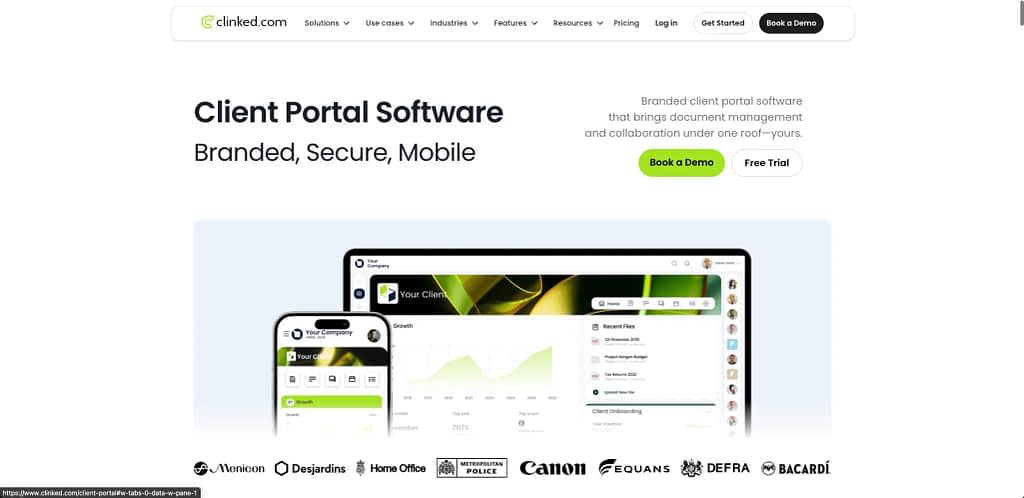
Clinked is built around locking down file sharing and access control, with ISO 27001 certification and two-factor authentication baked in, which makes it a natural fit for businesses handling sensitive client data, like legal or financial services firms, rather than general project collaboration.
Prices:
- Start Up: $8.80 per user
- Standard: $239/mo
- Premium: $479/mo
- Enterprise: custom pricing
Key features:
- Secure file sharing with version control
- Branded client portal
- Two-factor authentication
- ISO 27001 compliance certification
- Real-time chat
- White-label mobile app on the Enterprise tier
✅ Advantages of Clinked
- ISO 27001 certification is a real, verifiable security credential that matters for compliance-sensitive industries
- Strong file version control reduces the “which version is current” confusion that plagues email-based file sharing
- Real-time chat keeps client conversations tied to the relevant files
⚠️ Disadvantages of Clinked
- Entry pricing (around $119/mo) is noticeably higher than most client portals on this list, pricing out very small businesses
- Published pricing isn’t confirmed directly by the vendor, so exact current costs need a direct check
“I use Clinked to store and share financial documents, manage monthly updates with different departments, and collaborate with both internal teams and clients in one secure space. It makes the monthly close process smoother by showing me what items have been added or reviewed, so I don’t have to chase updates. The way folders can be structured by period helps keep everything easy to follow, and the previews make reviewing statements much faster.”
(Susan L, G2)
7. Moxo: Best for Enterprise Workflow Automation
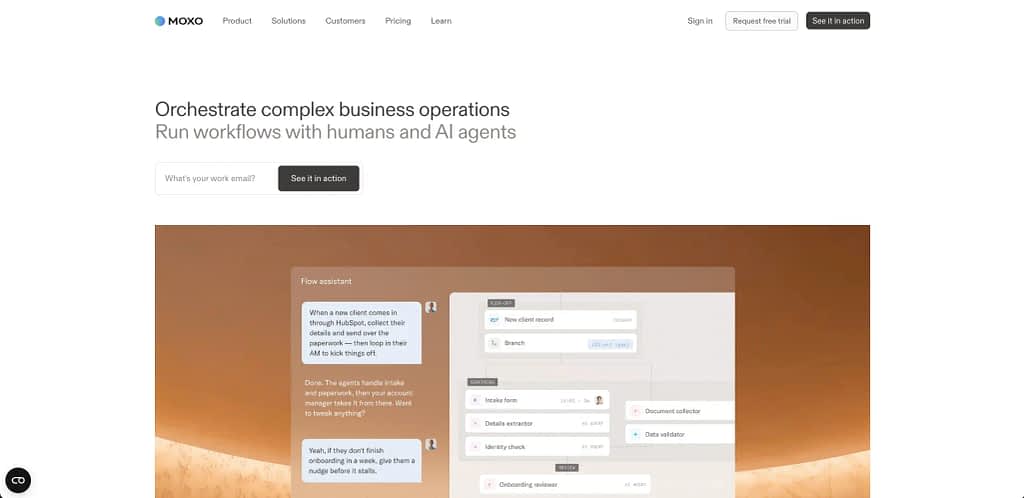
Moxo is built for structured, repeatable, multi-party approval processes, think client onboarding at a bank or a multi-step legal intake, where a workflow builder with branching logic and approvals matters more than a simple file-and-message portal.
Prices:
- Team $500/mo for unlimited seats, 250 flows per year
- Scale and Enterprise tiers are priced by custom quote
Key features:
- Visual workflow builder with an AI Copilot
- Branching logic and triggers for multi-step processes
- Built-in approvals and e-signatures
- Advanced client portal capabilities
- SAML SSO
- Native CRM integration on the Scale tier and above
✅ Advantages of Moxo
- Genuinely strong for complex, multi-party approval workflows that simpler portals can’t replicate
- Unlimited seats on the Team plan means cost doesn’t scale per user
- SSO and enterprise-grade access controls suit larger, more regulated organizations
⚠️ Disadvantages of Moxo
- $500/mo entry pricing puts it well out of reach for solo freelancers or small agencies
- The workflow-builder depth is overkill if you just need basic file sharing and invoicing
“We currently use the Moxo app to communicate with some of our clients, sharing updates and collateral with them. They’re even able to sign their onboarding documents through the app when they join their brokerage, which is incredibly useful. The ability to brand our app – and for two of our clients to brand their own – is great. We’ve found it to be a handy way for them not only to respond to us and provide feedback, but also to communicate with each other.”
(Jackie M, G2)
8. Client Portal (client-portal.io): Best for WordPress-Native Agencies
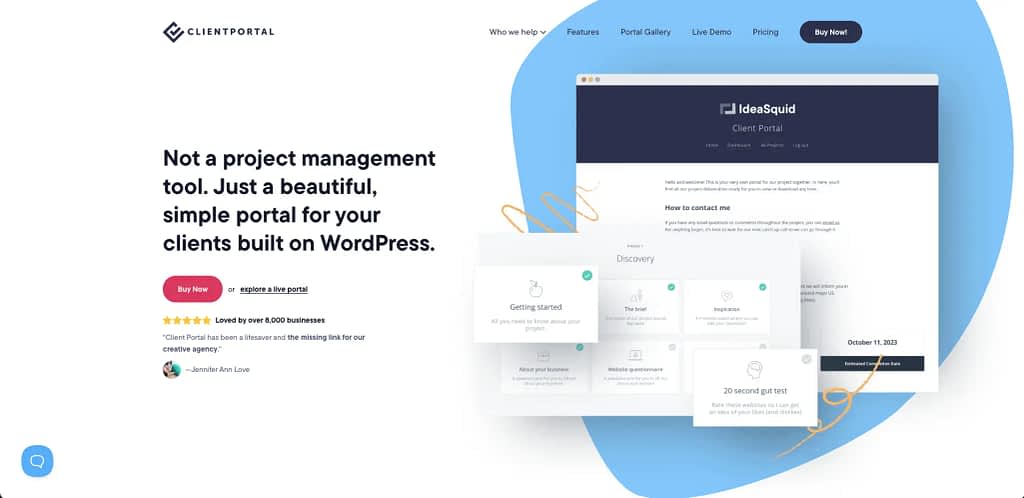
Client Portal.io is a WordPress plugin, not a separate SaaS platform, which means it adds private, per-client project pages directly to a WordPress site you already run, with no separate login system for clients to manage.
Prices:
- Single-site license $199/yr
- Multi-site license $399/yr
- Lifetime license (single site) $597
- Lifetime license multi-site $1,197
Key features:
- Native WordPress plugin, no separate portal platform to maintain
- Private, per-client project pages
- File, invoice, and deliverable storage tied to each client page
- Client notifications
- No-code setup inside the existing WordPress admin
✅ Advantages of Client Portal
- One-time or annual license fee instead of recurring per-user SaaS pricing, which is a meaningfully different cost model than every other client portal on this list
- No new login system for clients since it runs on a WordPress site they may already be familiar with
- Ideal if your agency already builds and hosts client sites on WordPress
⚠️ Disadvantages of Client Portal
- Tied entirely to the WordPress ecosystem, so it’s not an option if you don’t already run WordPress
- We could not confidently attribute a G2 listing to this exact product, so third-party review volume is effectively unclear
“I started setting up my first portal and I have to say: wow! This is so cool. I can’t believe how easy it is to add, change, and remove sections on the backend. And WOAH does that front end look professional. You made a very cool thing. Thank you.”
(Alli Blum, client-portal.io)
9. Assembly: Best for Branded Client Experiences
Assembly is a client portal built specifically around branding and no per-client fees, which matters for agencies whose client roster grows unpredictably and don’t want a portal bill that scales with headcount.
Prices:
- Free $0/mo (5 active contacts, 1 user)
- Starter $20/mo (annual) or $49/mo (monthly), 50 contacts and 1 user
- Professional $99/mo (annual) or $139, 500 contacts and 3 users
- Advanced $499 (annual) or $599 (monthly), unlimited contacts. and 5 users
Key features:
- Branded client portal
- Contracts with built-in e-signature
- Billing and invoicing
- In-portal messaging
- Forms and task management
- Embeddable reporting dashboards
- API and webhooks available on every tier, including the free plan
✅ Advantages of Assembly
- No per-client fees at any tier, which keeps costs predictable as your client list grows
- API and webhook access on every plan, including free, is unusually generous
- Includes AI app-builder credits for small custom client-facing apps
⚠️ Disadvantages of Assembly
- Free and Starter tiers cap active contacts fairly low (5 and 50, respectively), so growing agencies will outgrow them quickly
- Pricing for the Advanced tier is pretty steep, and while it doesn’t cap contacts, it’s only good for 5 users
“We love that our clients can communicate with us on one platform, pay bills, upload files, etc. and stay in the know about their projects. Another amazing thing is that they are constantly upgrading the features. They have recently rolled out an AI app-builder that can be customized to your team and clientele. One flaw of the system is the integration with Stripe. This would be better for us if we could bill through Quickbooks, since the Stripe platform is far more expensive than Quickbooks for processing fees.”
(James G, G2)
10. Zoho Creator: Best for Custom Portal Development
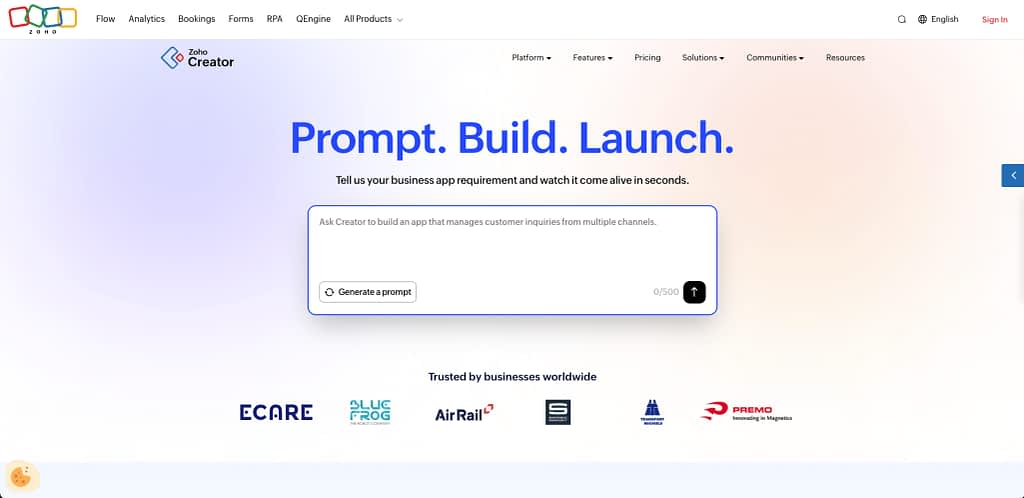
Zoho Creator is a low-code app builder, not a pre-built client portal, so it’s the right pick specifically if you want a fully custom portal built around your exact workflow without hiring a development team from scratch.
Prices:
- Standard $8/mo (annual) or $12/mo (monthly)
- Professional $20/mo (annual) or $30/mo (monthly)
- Enterprise $25/mo (annual) or $37/mo (monthly), priced per user, with a 15-day free trial available.
Key features:
- Low-code app and portal builder with drag-and-drop forms
- Workflow automation
- Deluge scripting for custom logic beyond drag-and-drop
- Deep integration with Zoho CRM, Zoho Books, and Zoho Sign
- Multi-platform deployment (web and mobile)
✅ Advantages of Zoho Creator
- Genuine low-code customization depth lets you build a portal shaped exactly around your workflow, not a generic template
- Tight integration with the rest of the Zoho ecosystem if you’re already using Zoho CRM or Books
- Per-user pricing is low relative to the customization power on offer
⚠️ Disadvantages of Zoho Creator
- You’re building a client portal, not buying one, so expect real setup time compared to an out-of-the-box client portal
- Deluge scripting requires some technical comfort to unlock the platform’s full potential
“In my day-to-day usage, Zoho Creator makes it very easy to build and manage custom applications using its intuitive drag-and-drop UI, while still allowing flexibility through Deluge scripting for more complex logic. I regularly use it to create forms, automate workflows, and integrate data across systems. The platform performs reliably as apps scale, integrates well with Zoho apps and APIs, and is cost-effective for the value it provides.”
(Sachin S, G2)
11. Softr: Best No-Code Portal Builder
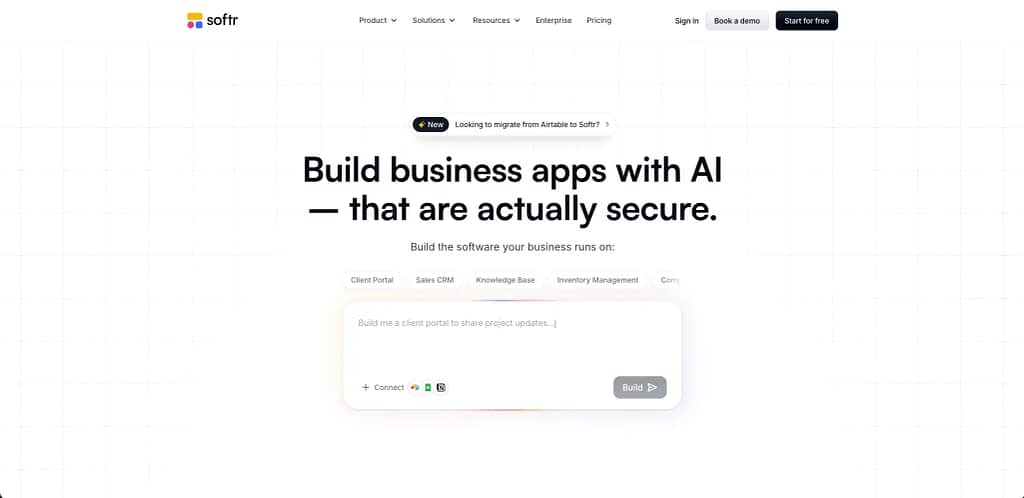
Softr turns an existing Airtable base, Google Sheet, or Zapier-connected data source into a live, client-facing portal without writing code, which makes it the fastest option here if your client data already lives in a spreadsheet-style database.
Prices: Free tier available (1 app, 10 users) · Basic $49/mo (annual) or $59/mo (monthly) · Professional $139/mo (annual) or $167/mo (monthly) · Business $269/mo (annual) or $323/mo (monthly) · Enterprise by custom quote.
Key features:
- No-code portal builder layered on top of Airtable, Google Sheets, or Zapier
- User groups and granular permission settings
- Custom domains
- SSO on higher tiers
- Pre-built templates for common portal layouts, so you can start from a proven client portal template instead of a blank portal template
✅ Advantages of Softr
- Fastest path from an existing spreadsheet or database to a live, functioning client portal, so you can get a portal quickly without a development sprint
- Free tier is genuinely usable for testing before committing
- No-code approach means non-technical team members can build and maintain it
⚠️ Disadvantages of Softr
- You need an existing Airtable/Sheets setup (or willingness to build one) to get real value out of it
- Pricing climbs quickly once you need SSO or higher user counts on the Professional and Business tiers
“The most helpful thing about Softr is the speed at which ideas can be turned into working solutions. As someone who is not a developer, I was able to build a supplier portal connected to Make.com and automate large parts of our communication process. The user management, permissions, and overall ease of use make it possible to solve real business problems without a dedicated development team.”
(Marcel M, G2)
12. MyDocSafe: Best for Secure Document Workflows
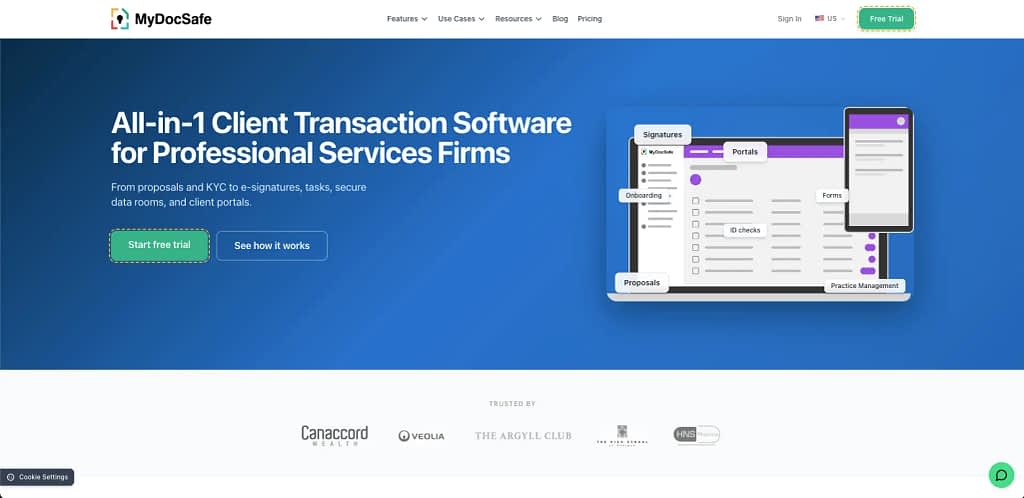
MyDocSafe centers on compliance-first document handling, e-signatures, secure vaults, and automated reminders, aimed at professional services firms (legal, financial advisory) where document workflow and audit trail matter more than a polished client dashboard.
Prices:
- Business Pro $25 per user per month
- Accounting Pro $36 per user per month
- Deal Pro: $63 per user per month
- Enterprise: Custom pricing
Key features:
- E-signature functionality
- Secure document vault with workflow automation
- Client onboarding forms
- Guest portal access for clients without a full account
- Automated reminders for outstanding documents
- GDPR-oriented compliance tooling
✅ Advantages of MyDocSafe
- Compliance-first design suits regulated professional services that need a defensible document audit trail
- Guest portal access lets clients complete tasks without a full account setup, reducing friction
- Per-signature pricing beyond the free monthly allotment is transparent and predictable
⚠️ Disadvantages of MyDocSafe
- G2 review volume is small (16 reviews), so there’s limited third-party data to judge consistency at scale
- Enterprise pricing isn’t public, requiring a sales call to get a real quote
“Quick and easy to use. Looks safe enough. Several features built in even for signing and selection makes it easy.”
(Ahmedi B, G2)
13. Notion: Best Budget/DIY Option
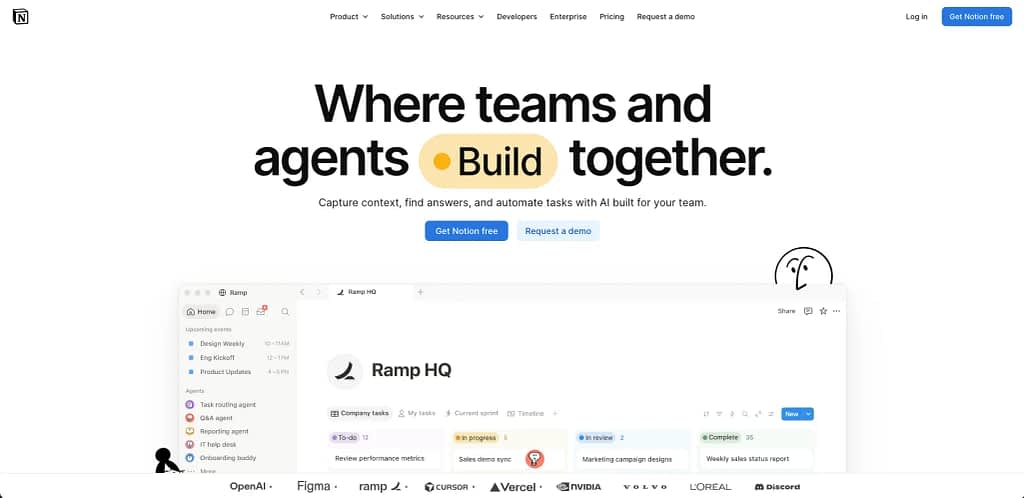
Notion isn’t a purpose-built client portal, and it’s worth saying that plainly: there’s no native branding-as-a-product, no built-in invoicing, and no e-signature. It’s included here because a serviceable client-facing workspace can genuinely be built on Notion’s free or $10/mo tier using guest permissions, shared databases, and templates, which makes it the realistic budget option for a business that isn’t ready to pay for a dedicated client portal yet.
Prices:
- Free $0/mo
- Plus $9.50/user/mo (annual) or $11.50/mo (monthly)
- Business $19.50user/mo (annual), which bundles Notion AI
- Enterprise by custom quote
Key features (relevant to client-portal use):
- Shared workspaces and pages
- Guest access for external clients
- Databases and tables for tracking client work and deliverables
- Per-page permission settings
- Templates for common client-facing layouts
- Embeds for files, forms, and other tools
✅ Advantages of Notion
- Effectively free (or $10/mo) to build a working client-facing workspace, undercutting every dedicated client portal on this list
- Extremely flexible; databases and templates can be shaped into almost any layout
- Massive template ecosystem means you rarely start from a blank page
⚠️ Disadvantages of Notion
- No native invoicing, e-signature, or payment processing, so you’ll need separate tools for those
- No branding-as-a-product; a Notion-based portal will look and feel like Notion, not your brand, without significant workaround effort
- Client-facing permissions require careful manual setup to avoid accidentally exposing internal pages
“Since switching to Notion, life has become significantly easier for our entire team. The interface is simple and intuitive, so it’s easy to get started without any special knowledge or training. I actively use databases and templates, and one of the biggest benefits for us is that all our information now has a clear and consistent structure. We use Notion as a central place for almost all of our company documentation — internal instructions, training materials, product updates, research, coaching session notes, presentations, and much more.”
(Anastasia G, G2)
14. TaxDome: Best for Accounting and Bookkeeping Firms
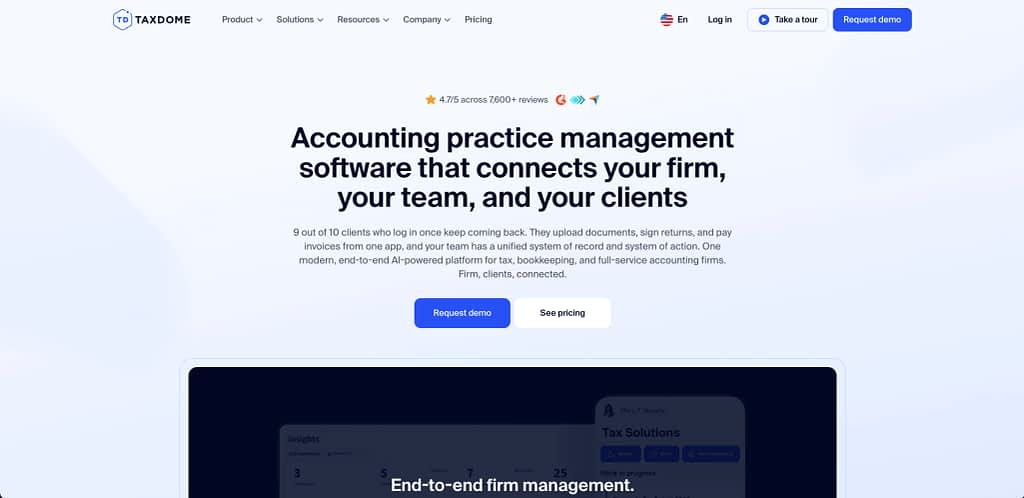
TaxDome is purpose-built for tax, accounting, and bookkeeping firms specifically, with automation designed around the document-heavy, deadline-driven intake process that defines tax season, and it currently ranks #1 in G2’s tax practice management category.
Prices:
Essentials is priced around $800/user/yr, capped at 1 user, aimed at solo practitioners
Pro is priced around $1,000/user/yr on annual billing
Business is priced around $1,200/user/yr on annual billing
Key features:
- Client portal with built-in e-signature
- Secure messaging
- Automated workflows and pipelines for repeatable client intake
- Billing and invoicing
- Document management
- White-label mobile app on the Business tier
- QuickBooks integration
✅ Advantages of TaxDome
- Deep automation specifically for tax-season document collection and client intake, a real differentiator versus general-purpose portals
- Ranked #1 in G2’s tax practice management category, with a large review base (3,500+) backing that up
- QuickBooks integration fits naturally into an existing accounting firm’s toolset
⚠️ Disadvantages of TaxDome
- Pricing (roughly $800-$1,000 per user, per year) is steep if you’re not specifically an accounting or tax practice
- Business tier pricing isn’t public, so larger firms need a sales conversation to budget accurately
“TaxDome does an incredible job at making an incredibly powerful, complex software into an intuitive tool for both the firm and the clients. I recommend dedicating a significant amount of time to training or learning the automations. However, the performance has been great – and I have had no issues at all. I hope that TaxDome prioritizes more integrations, especially secure ai integrations, in the future.”
(Sean M.G, G2)
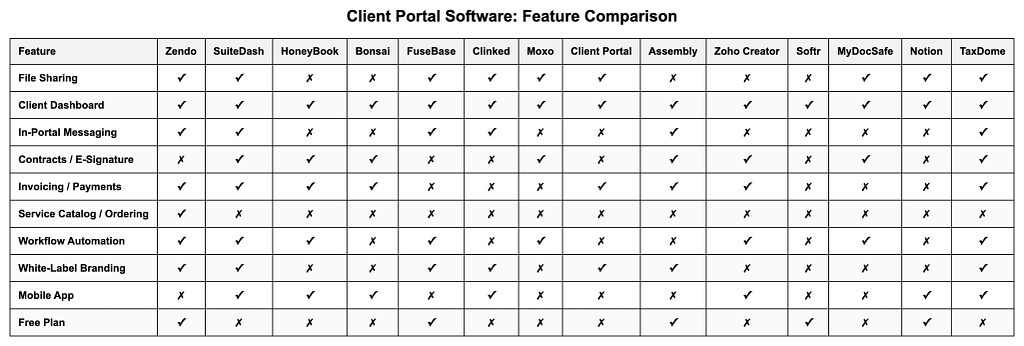
Feature Comparison
Pricing and star ratings only tell part of the story, so here’s how all 14 client portals stack up on the features that actually differentiate them day to day. A ✗ means the feature isn’t part of the client portal’s core, advertised offering, not that it’s technically impossible to hack together.
How to Choose the Right Client Portal Software for Your Business
The fastest way to find the right client portal is to start from your business model, not a generic feature checklist, since the same feature list (files, messaging, invoicing) means something different depending on how you actually sell.
Productized or subscription service businesses should prioritize client portals with a built-in service catalog or storefront and no per-transaction fees eating into margin on repeat sales. Zendo and Assembly fit this pattern most directly.
All-in-one business management matters most if you’re trying to replace several separate tools (CRM, invoicing, proposals) with one flat-priced system. SuiteDash and FuseBase both lean this direction.
Project-based and creative freelancers usually get more value from a strong proposal-to-payment pipeline than deep customization. HoneyBook and Bonsai are built specifically around that flow.
Enterprise or regulated businesses need to prioritize compliance certifications, access controls, and workflow automation over a low starting price. Moxo, Clinked, MyDocSafe, and TaxDome all target this end of the market, each with a different specialty (workflow automation, file security, document compliance, and tax-specific automation, respectively).
If none of the above fits cleanly, and you either already run WordPress or already have client data in a spreadsheet, Client Portal and Softr solve for those specific starting points rather than a business model. If project management is your actual bottleneck rather than client communication, a heavier tool like SuiteDash will feel more natural than a lightweight portal.
And if what you need is an AI-powered customer portal for an anonymous support queue rather than a named client relationship, a customer support portal built for ticketing beats anything on this list; picking the right customer portal software for that use case is a genuinely different exercise than picking from the leading client portal software built for named clients, which is what this guide focuses on.
Several of these tools also double as lightweight client relationship management systems, and SuiteDash and Zoho Creator function as relationship management software as much as they do a client portal, which matters if you don’t want to run a separate CRM alongside your portal.
Whether you think of it as a client portal system or a client portal platform, the underlying question is the same: does it fit how your business actually runs? A great client portal disappears into the background of a good client relationship instead of becoming one more thing to manage.
There’s no shortage of client portal software solutions in this category, which is exactly why matching the tool to your business model matters more than picking whatever ranks first. If your team needs to choose the right customer portal for a large, anonymous audience rather than choose the best client portal for a defined client roster, look at our self-service comparison instead for a client portal that allows self-service at scale.
Day-to-day, good portal software helps with client management the same way a lightweight CRM does. Portal software allows a small team to look organized without hiring an ops person, and what that portal software should include, at minimum, is clear per-client structure so performance and client satisfaction don’t quietly slip. A genuinely secure portal backed by real access controls matters more once you have real client and financial data flowing through it. If none of these 14 client portals feel right after all that, the honest answer is to trial two finalists with real client portals of your own data before you choose a portal for good.
Conclusion
The right client portal isn’t the one with the longest feature list; it’s the one built around how your business actually sells: productized or subscription packages, all-in-one management, project-based creative work, or regulated professional services.
Match the client portal to that model first, and the pricing and feature tradeoffs above should make the shortlist obvious. Client portals are cheap to trial and expensive to switch once your clients are used to logging into one, so test the actual client experience yourself before committing.
Try Zendo free if you run a productized or subscription service business and want to see whether a $0-transaction-fee portal and storefront fits how you work.
Frequently Asked Questions
What’s the difference between a client portal and a customer portal?
A client portal centers on an ongoing relationship with a specific, named client: project history, files, and invoices. A customer portal is a self-service layer for a much larger customer base, covering order history, support tickets, and account settings. This guide focuses on the client-relationship side of that distinction.
How much does client portal software cost?
Pricing ranges from genuinely free (Zendo, Assembly, Notion, Softr) to $500+/month for enterprise workflow tools like Moxo. Most small-business-focused portals fall between $9 and $100/month. A few, like Client Portal (client-portal.io) and TaxDome, use annual or one-time licensing instead of monthly SaaS pricing.
Can I build my own client portal?
Yes. No-code tools like Softr can turn a spreadsheet into a functioning portal, low-code platforms like Zoho Creator let you build something fully custom, and Notion can be shaped into a basic client-facing workspace with guest permissions. None of these include built-in invoicing or e-signature by default, so budget time to add those separately.
Do freelancers need a client portal?
Not always, but it pays off once you’re juggling more than a couple of active clients across scattered emails and files. Freelancer-focused portals like HoneyBook and Bonsai bundle the portal with contracts, invoicing, and proposals in one flow, replacing several separate tools with a single branded login.
Is a client portal the same as a CRM?
No, though some tools (like SuiteDash and Zoho Creator) bundle both. A CRM tracks leads, contacts, and sales pipeline internally; a client portal is what your paying clients log into to see their own project, files, and invoices. Some businesses need both, while others pair a lighter CRM with a strong portal.