

Winning a new client is half the battle. What truly determines whether they stay, expand the cooperation, or quietly disappear after the first project is—to a large extent—how you onboard them.
A structured onboarding process helps clients understand how you work, what happens next, and how quickly they can start seeing value. When done right, onboarding helps transform new customers into happy clients by building clarity and confidence from day one. Without it, confusion replaces excitement, client satisfaction drops, and that’s where churn sneakily creeps in.
This complete onboarding guide will show you how to onboard new clients step-by-step, discover proven best practices, and see how a modern onboarding platform like Zendo can turn onboarding into a scalable, repeatable process instead of a manual routine.
If you run a service-based business, you’ll get even more value because helping agencies, freelancers, and subscription services build smoother onboarding experiences is exactly what we specialize in!
PS, if you crave real-life examples, you’ll also find some good inspiration and anti-inspiration to hopefully make this whole process a bit more fun.
But first…
Why Do We Dare to Call Ourselves Onboarding Experts?
We don’t claim onboarding expertise based on theory, but on observing dozens of service businesses systemize how clients start working with them.
Take Etch Design, a subscription-based design agency built around unlimited creative requests that uses our software, Zendo.
Before implementing structured systems, managing incoming work and communication across clients risked becoming chaotic, which is a common growing pain for productized creative services.
By centralizing requests, communication, and client guidance inside Zendo from day one, Etch created a predictable onboarding experience where nothing “gets lost in the shuffle”, helping them scale to increasing demand and even build a waitlist for new clients.
A similar pattern appeared at Innovatiana, an AI data-labeling company facing fragmented communication and slow response times as client volume grew.
After introducing a unified client portal and structured workflows, the team reported faster response rates, reduced operational delays, and noticeably higher client satisfaction—outcomes that almost always trace back to clearer onboarding and early expectation alignment.
Across creative agencies, consultancies, and productized service teams using Zendo, the lesson repeats itself: client experience problems rarely start during delivery…they start during onboarding.
What Is Client Onboarding in Service-Based Businesses?
Client onboarding is the structured process of introducing new clients to how your service works, what happens next, and how collaboration will succeed.
For service businesses, onboarding typically includes:
- sharing the next steps,
- setting communication rules,
- sharing workflows and timelines,
- guiding clients toward their first measurable outcome,
- introducing the client portal and explaining how to submit further requests (if applicable).
Before onboarding is the best moment to collect project or business information and define goals and deliverables by the customer.
Why Is Client Onboarding Important for Services?
If you clicked on this article, chances are you already deem onboarding your customers a pretty important part of your service delivery process, right?
If that’s somehow not the case, take a quick peek at these real-life examples of onboarding going wrong and you should change your mind about its importance super quick.
Before we get to the juicy examples, let’s go over exhibit A in the client onboarding case. This one Reddit user asks:
“Why does every company act like selling is the finish line when onboarding is where customers actually decide to stay?”
And we have the exact same question: why? Because treating customer onboarding as an afterthought leads to real issues, from dissatisfied clients to actual churn.
Like in these examples below.
4 Real Examples of Bad Client Onboarding
Starting with the one we’ve all experienced…
1. Facebook Marketplace: Hello, Is This Available?
Sometimes, first experiences go from confusing to downright absurd.
If you’ve ever used the Facebook Marketplace to sell anything, you’d know the infamous “Hello, is this available?” messages sent by friendly human ghosters, all the time.

Quick intermission for referencing the popular song by Lubalin, “Internet Drama Part 1 (Is This Available?)”. The real conversation one Facebook user had that inspired the track goes something like this:
“Hello, is this available?”
“Yes it is.”
“Please leave me alone, we are sleeping.”
“???”
“No more contacting please, thanks, appreciate.”
“You contacted me.”
“I know, no longer interested.”
“Please stop contacting me now, I will contact the attorney general if you do not stop, thanks.”
Hope you sang that one with us.
Now, while hilarious, it perfectly illustrates a real problem: customers often don’t know what to do next, interactions are mismanaged, and frustration escalates quickly when initial communication is chaotic from the start.
Of course, this example is a bit exaggerated, but it’s not like it doesn’t happen in professional settings at all, right?
In service-based businesses, the same thing can happen if clients aren’t guided properly from day one. They may misunderstand the process, get confused, or even disengage entirely, essentially ghosting you…just like on Facebook Marketplace.
Thoughtful onboarding is the antidote: it gives clients a clear path, sets expectations, and ensures the first interaction feels seamless instead of chaotic.
2. Salesforce: Getting Serious About Confusing Setup and Frustrating Experience
Who in here hasn’t been personally victimized by complex, and often, outdated software platforms? Raise your hand. 🤨
Salesforce is one of the main offenders here.
Its G2 rating, although high (4.4 out of 5 stars), covers exactly that with nearly 2 thousand reviews mentioning the steep learning curve. Now, a steep learning curve is not a crime in itself, right?
With complex, powerful software, it’s often the case that the platform is a little tricky to grasp. What’s crucial in cases like this one is either dedicated help from the CSMs from the start or a perfect client onboarding experience.
Unfortunately, Salesforce doesn’t seem to have one set up in place. At least according to some users (not everyone complains about this). But a lot of G2 users do:
“The learning curve is steep; onboarding new team members requires significant dedicated training time to get them comfortable with our customized instance.” G2 review
“The initial setup and onboarding can be quite complex, often requiring external expertise or training, which can be a hurdle for smaller teams or businesses new to CRM tools.” G2 review
Reddit is not free from these complaints about Salesforce onboarding either, like this Reddit user saying:
“We (small startup) have solid inbound sales and are building our outbound sales. Hubspot really wasn’t working for us at this point so we switched over to Salesforce. Just got in last week, and its incredible how there is just ZERO onboarding help at all.
We just have a few core functionalities we’re looking to accomplish, but something as simple as email tracking/logging to the right “Accounts” page feels super buggy and totally over-engineered”.
Salesforce may not suffer from a significant ARR loss due to poor client onboarding, but a big chunk in churn that could add more money into the pipeline instead of taking away from it? Quite possible.
3. Fly High or Pay: Ryanair and Wizzair Worst Measurement Explanations
Poor onboarding is not just about frustrations, though. It can actively damage trust.
A well-known example comes from budget airlines like Ryanair and WizzAir, where passengers frequently complain about confusing carry-on baggage rules.
Many travelers only discover restrictions at the boarding gate and are forced to pay unexpected fees, even after believing they followed instructions correctly.
Like this Reddit user:
“Flight from Bratislava, bought priority. My luggage is exactly the same size as needed, while it also fits in the box. However, my luggage has a extra rubber pointed out (for protection) that didnt even exceed the metal box. The grumpy lady mentioned that my luggage was “2CM” larger than the labels because of the rubber end, which apparently is marked inside the box.
Got charged 75 euros extra in additional to priority and normal ticket.”
Now imagine it was this passenger’s first-time traveling experience. Researched and prepped correctly, yet, still had a bad experience.
The same dynamic happens in service-based businesses: when clients don’t clearly understand processes, deliverables, or responsibilities immediately after purchase, frustration appears long before results are delivered.
Effective client onboarding prevents these “boarding-gate moments” by aligning expectations from day one.
4. In a Pickle with Design Pickle: Graphic Design Bad Mouth
A similar onboarding problem can very much also appear in creative subscription services, the exact type of business many design, marketing, copywriting, or video agencies operate today.
Customer reviews of Design Pickle, a well-known productized design service, often reveal frustration beginning immediately after purchase rather than during delivery itself.
Some clients describe waiting “hours—or even days—just for someone to acknowledge or look at a job,” while others note they were expected to provide “about 75% of the creative direction” before work could even begin.
Several reviewers also point to confusion around workflows and transparency, mentioning there was “no client-facing time tracking or hourly breakdown at all”, despite pricing being tied to available design hours.
These experiences highlight a common issue in service-based businesses: when onboarding fails to clearly explain how requests work, what inputs are required, or what clients should expect next, customers feel lost before value is ever delivered.
And they won’t keep it to themselves if it’s frustrating. You risk getting bad reviews, bad word of mouth, and potentially lose out new customers.
What These Examples Teach Us?
📍 First impressions matter, deeply.
Customers judge value and trust within early interactions, whether a product or service.
📍 Confusion and silence kill retention.
Leaving customers without guidance or clarity—after purchase or at first use—pushes them to competitors.
📍 Real costs are in churn and reputation.
Negative first experiences spread widely online and dramatically influence long‑term loyalty.
Service businesses face a unique challenge, though.
Clients don’t immediately see a finished product. So they must trust the process first. More on that in a bit. 😉
What Makes Onboarding New Clients Successful? 10+ Best Practices
If you look at real-world onboarding success stories, one pattern appears again and again: structured onboarding directly reduces churn.
In a popular Reddit case study shared by a SaaS founder, their team reported that they “slashed churn by 34% through onboarding” after fixing how new customers were guided post-purchase.
The biggest change was creating clarity after the sale.
So, instead of leaving customers wondering what to do next, they introduced structured onboarding steps, clearer expectations, and human touchpoints at the right moments.
That insight applies even more strongly to service-based businesses.
Unlike apps, services don’t deliver instant value. A client buys design, marketing, copywriting, or video services, but results only happen after collaboration begins.
If onboarding fails, clients feel lost before work even starts.
So what actually works?
Below are the best practices for onboarding new clients, translated into practical actions you can implement immediately, especially using Zendo. 😉
1. Give Clients Immediate Post-Purchase Clarity They Won’t Lose
The biggest onboarding mistake is complete silence after payment. Or a vague message that doesn’t say anything of value and gets easily lost in the never-ending email chains.
Clients shouldn’t receive a vague confirmation email and wait days wondering what happens next.
In Zendo
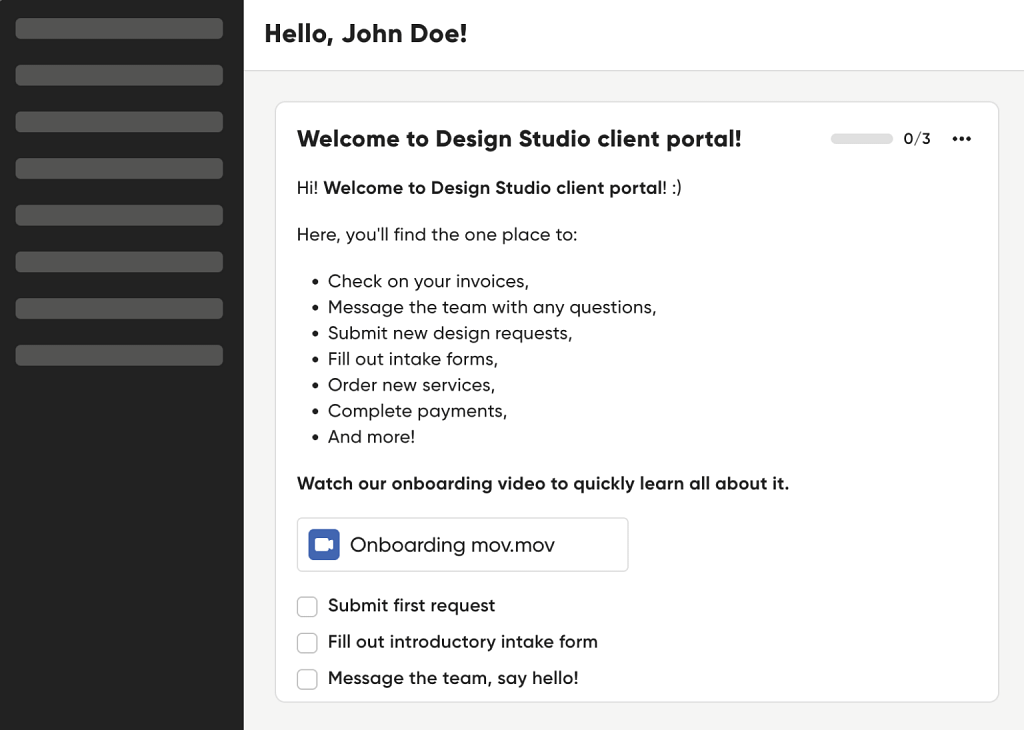
Create an Onboarding Card that automatically appears on the client dashboard right after purchase.
Use it to show:
- what happens next,
- timelines,
- communication rules,
- first required actions,
- whatever you need to say to make clients succeed fast.
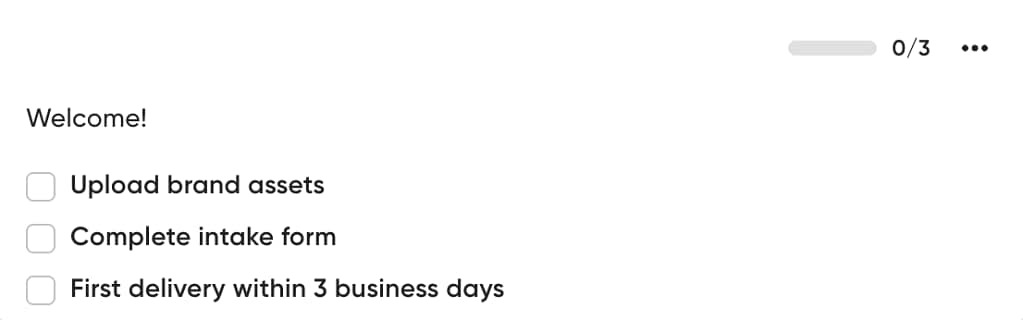
Example:
“Welcome!
Step 1: Upload brand assets.
Step 2: Complete client intake form.
Step 3: First delivery within 3 business days.”
This removes uncertainty instantly.
It may look simple like this or even more fancy:
2. Personalize Onboarding by Service Type
Not every client needs the same onboarding.
A subscription design client, a one-off branding project, and a custom marketing engagement all require different starting points.
So give them different starting points to make it as relevant as possible.
In Zendo
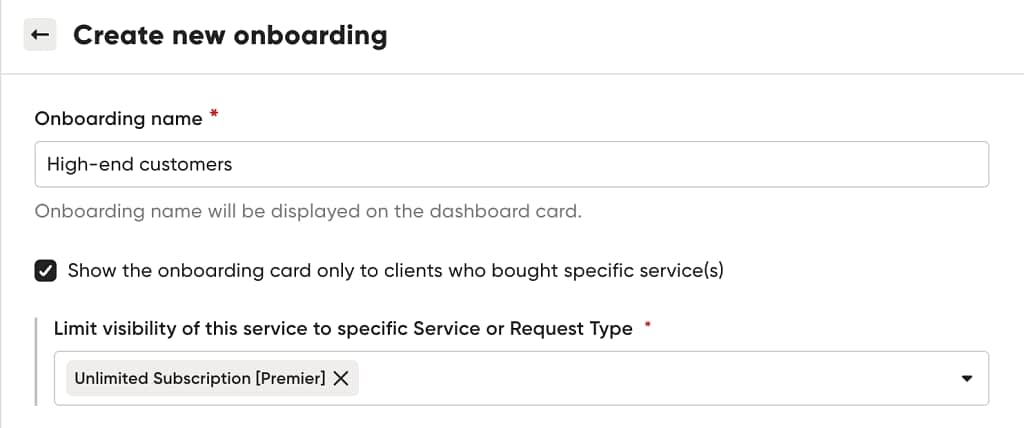
In Zendo, you can restrict onboarding cards to specifically purchased services.
This allows you to create:
- onboarding for specific productized packages,
- onboarding for subscriptions,
- onboarding for custom projects,
- onboarding for high-end clients,
- you get it.
Clients only see what’s relevant, reducing confusion and overwhelm.
3. Guide Clients Toward Their First “Win”
Successful onboarding focuses on helping clients reach value quickly.
Reddit onboarding discussions repeatedly highlight that churn drops when users achieve an early success milestone instead of being overwhelmed with information.
For service businesses, that first win might be:
- submitting their first request,
- approving a concept,
- receiving the first deliverable.
In Zendo
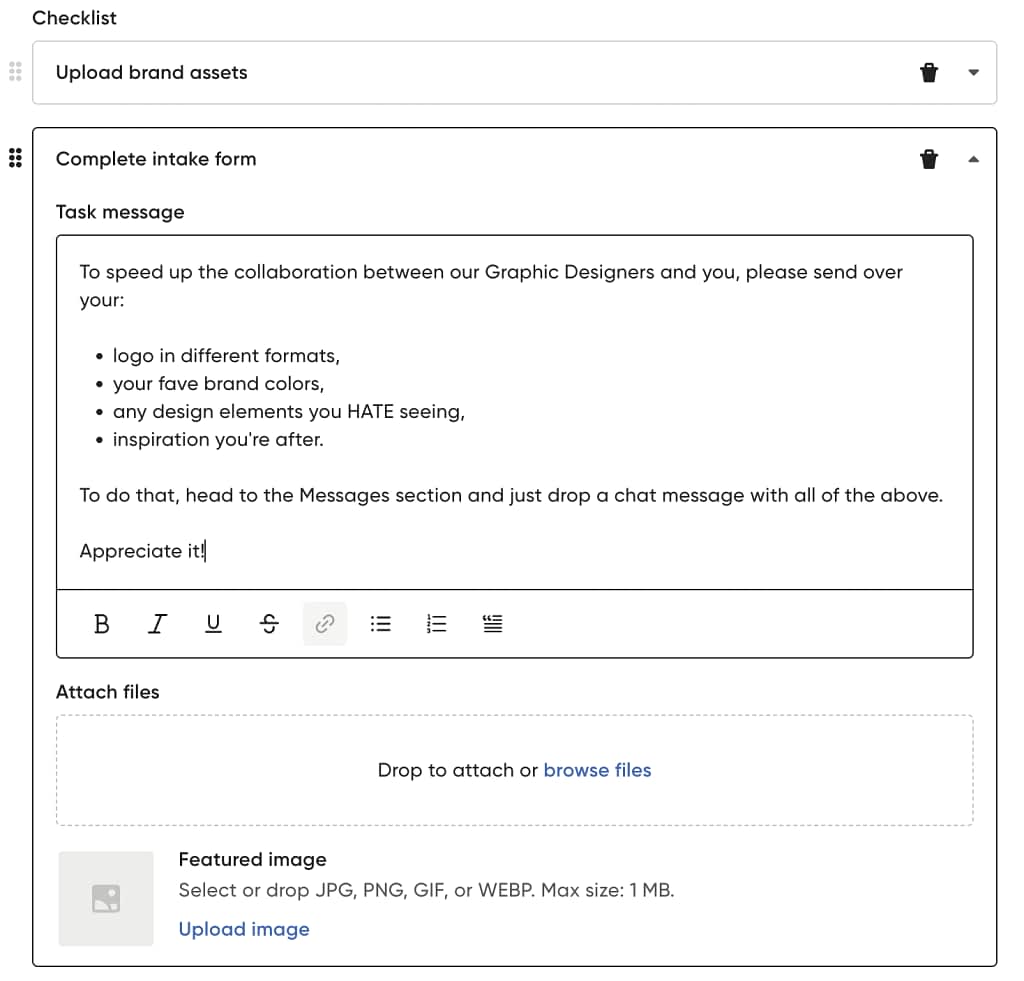
Add a checklist inside the onboarding card, such as:
- ✅ Upload brand guidelines
- ✅ Add team members
- ✅ Submit first task
- ✅ Review delivery process
Progress creates momentum and confidence.
4. Replace Long Explanations with Visual Guidance
Clients rarely read long onboarding documents.
They engage faster with visual or actionable guidance.
In Zendo
Upload directly inside onboarding cards:
- short Loom videos,
- PDFs,
- example requests,
- workflow walkthroughs.
Instead of explaining your process in emails, show it once, accessible in the client portal upon welcome.
5. Align Expectations Early
Many service frustrations come from mismatched expectations, not poor execution.
Clients may assume:
- unlimited revisions,
- instant turnaround,
- strategy included in execution work.
And if their assumptions turn out untrue, dissatisfaction creeps in.
In Zendo
Use onboarding messaging to clearly define:
- response times,
- revision limits,
- communication channels,
- delivery cadence.
You can format the text however you want and add any files or images to support your case.
When expectations are clear from day one, support tickets—and churn—drop dramatically.
6. Let Clients Self-Serve Instead of Waiting
One major onboarding improvement noted in churn-reduction discussions is eliminating dependency on manual responses. Customers shouldn’t need to email support just to understand basic steps.
So…
In Zendo
Centralize onboarding resources so clients can:
- preview files,
- download materials,
- check progress,
- revisit instructions anytime.
Your onboarding becomes scalable without feeling impersonal.
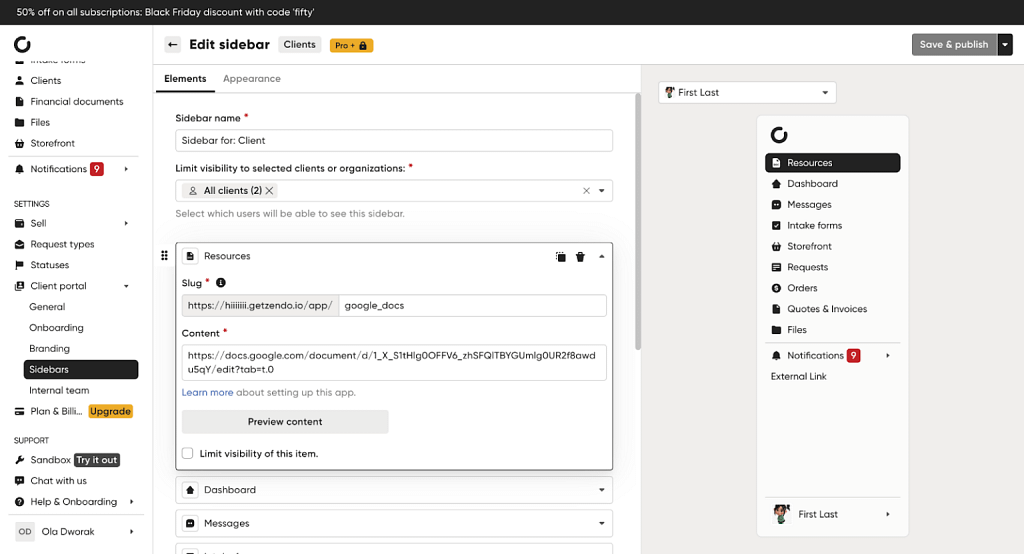
Going beyond a simple message, you can create a whole page with all the necessary and ever-green-available resources for your customers.
Or…
Link to your help center page directly in a dedicated space!
7. Continuously Test and Improve
Great onboarding is never finished.
Small adjustments—wording, order of steps, or required actions—can significantly impact client retention.
In Zendo
You can:
- duplicate onboarding cards,
- edit workflows,
- preview via impersonation,
- test improvements safely in a dedicated Sandbox environment.
Optimize onboarding like a product, not a document.
To make sure the onboarding works perfectly for ya, do a few things listed above before it’s actually shown to your clients.
8. Intake forms
Even the most effective onboarding breaks down if you start working without the information you actually need to start the work.
Many service businesses win a client and immediately jump into delivery. Then the questions begin. Assets are missing, expectations are unclear, and projects stall before they even properly start.
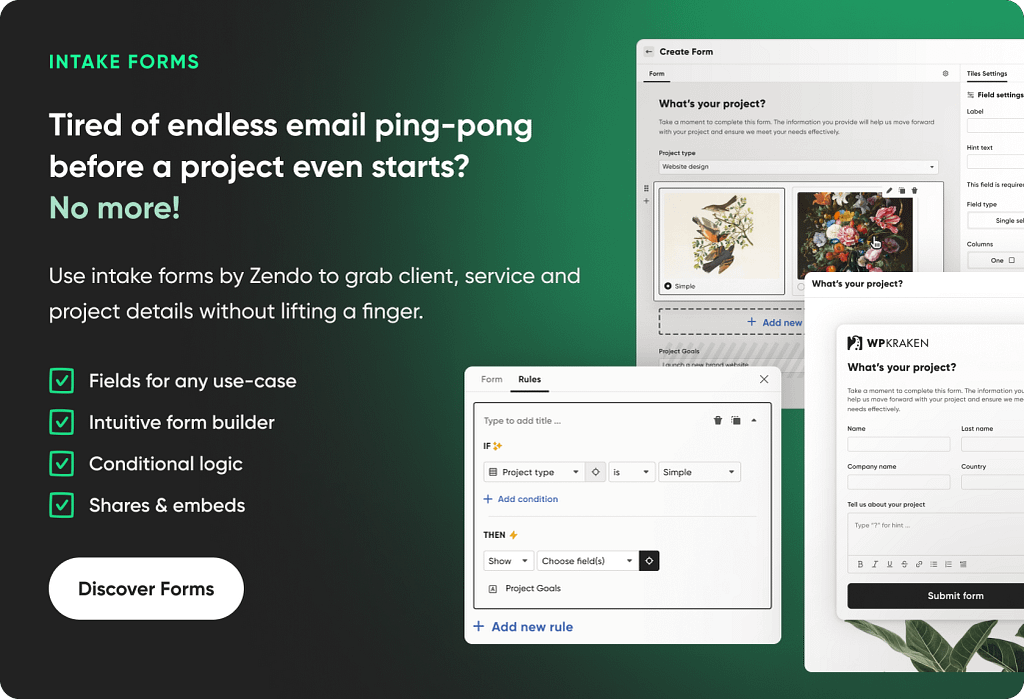
Using structured onboarding questions for new clients allows you to gather critical project details upfront, before work begins. An intake form ensures your onboarding process moves smoothly from purchase to execution without unnecessary back-and-forth.
In Zendo
You can:
- create structured intake forms tailored to specific services,
- ask onboarding questions specific to each project type,
- collect files, brand assets, and requirements upfront,
- allow repeat submissions for ongoing work,
- send forms directly to client dashboards,
- embed forms into your website or onboarding flow.
Instead of chasing information across emails and messages, everything arrives organized in one place, automatically, from the get-go.
9. Automated first message
One of the biggest onboarding mistakes service businesses make happens immediately after purchase: nothing happens.
A client buys your subscription, design package, or service—and silence follows.
No confirmation of next steps.
No reassurance for new users that they made the right decision.
That first interaction sets the emotional tone of your entire relationship.
A strong, automated welcome message instantly removes uncertainty and shows clients that your system for onboarding new customers is structured, professional, and ready from day one.
And it has to come in fast.
In Zendo
To kick off meeting new clients in an actually efficient way, use…automations and triggers.
Triggers in Zendo allow you to define an Action that happens automatically in response to an Event, ensuring every client receives consistent onboarding without manual effort.
Available trigger events include:
- Creating new request,
- Agent assigned,
- Request status changed,
- Request state change,
- Request archived.
Available automated actions:
- Change status,
- Send message (automated message we spoke about),
- Send intake form.
Like…
Welcome message after purchase
When a new request is created, automatically send a message that:
- welcomes the client,
- explains onboarding steps,
- shares onboarding questions for new clients,
- sets expectations upfront,
- explains how to schedule or prepare for the kick-off meeting.
Instant progress visibility
When an agent is assigned, automatically change the request status to In progress, reassuring new customers that work has already started.
Automatic feedback collection
When a request is archived, automatically send an intake form asking clients for a review or satisfaction feedback.
10. Perfectly crafted services
Part of effective onboarding is having perfectly crafted services from the start.
When your services are clearly defined, with scope, price, and deliverables, onboarding new customers becomes smoother and faster.
Clients know exactly what to expect, and your team can deliver without confusion.
In Zendo
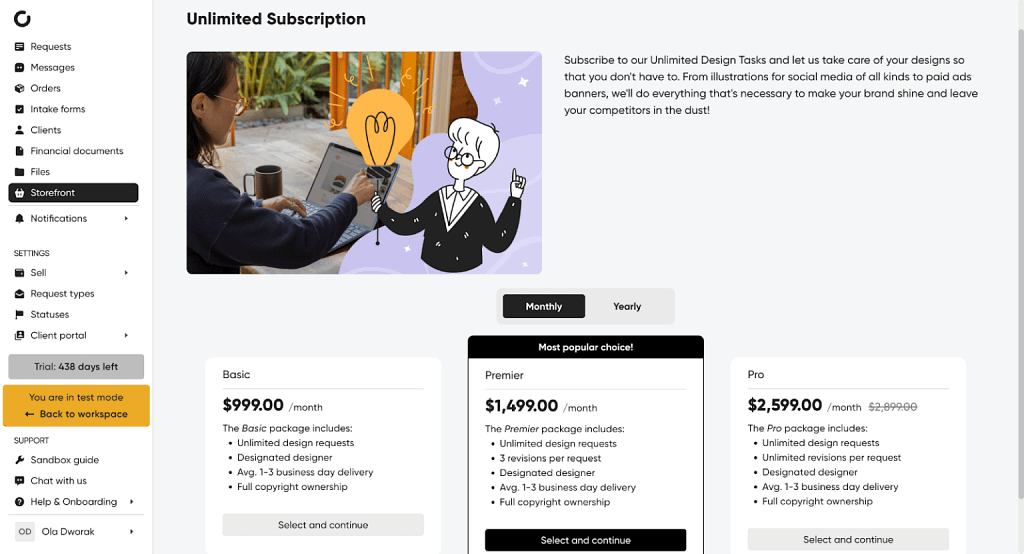
With Zendo, you can create productized or subscription services that clients can purchase upfront. Each service can include multiple request types, clear descriptions, images, and order forms to gather all the necessary information upfront.
Why it works for onboarding new clients:
- Clients see exactly what they get and how to submit requests.
- Intake forms and order forms collect all necessary details automatically.
- Stand-alone service URLs and Storefront visibility give clients easy access to their purchased services.
- Packages, free trials, and optional add-ons allow you to tailor the experience without overcomplicating onboarding.
11. No chaos on your end with Kanban
Even with the smoothest onboarding, your customer success team and customer support need structure to handle incoming client requests efficiently.
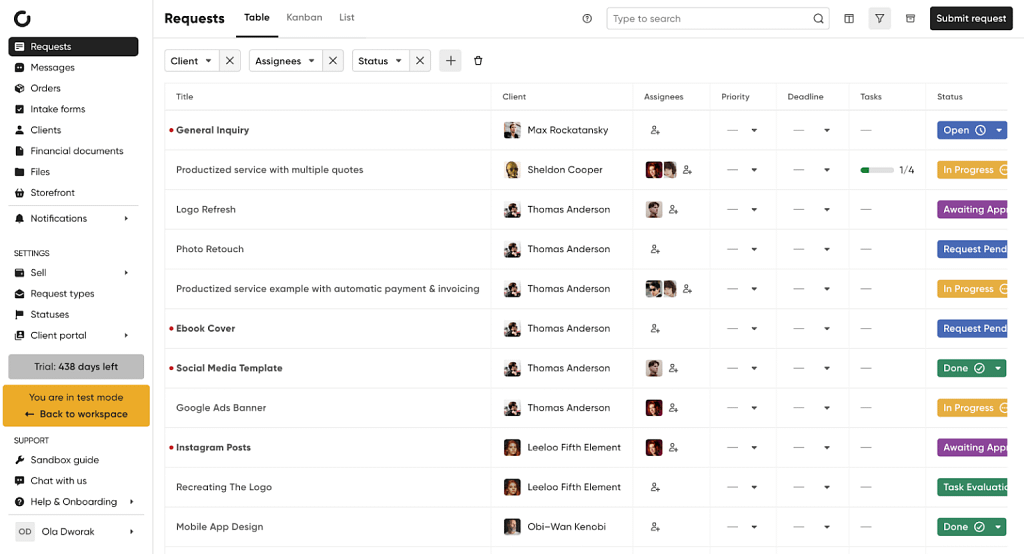
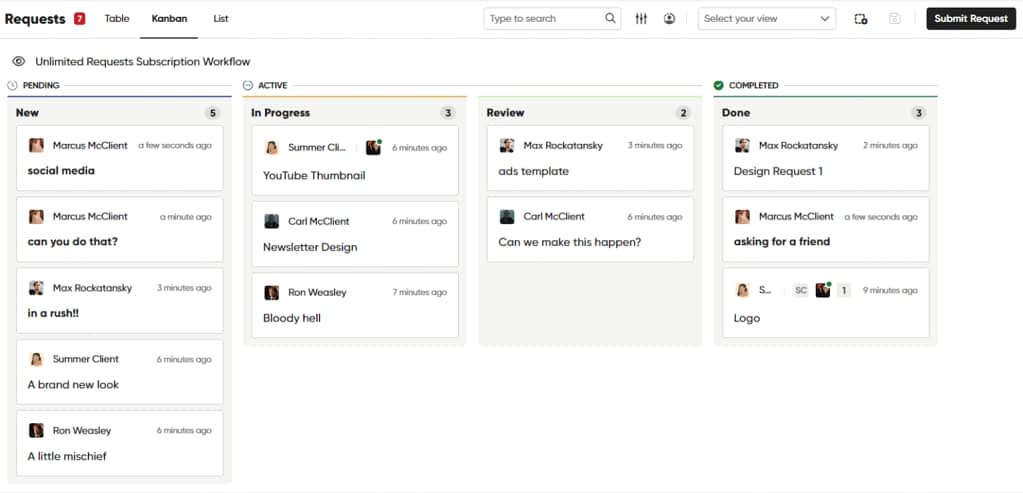
That’s where Zendo’s Kanban view comes in for extremely efficient project and service delivery org.
In Zendo
The Kanban board organizes all requests by status, like Pending, Active, or Completed, giving your team a clear, helicopter view of every client interaction.
Each request thread includes messages, file sharing, checklists, and even quotes or payment tracking.
Why it matters for onboarding new customers:
- Your support team sees all tasks at a glance, reducing the regular confusion associated with managing multiple projects at once.
- Agents can be assigned to requests, watchers stay in the loop, and priorities are clear.
- Custom fields and checklists ensure nothing falls through the cracks.
- Filter, sort, or switch views can be used for maximum clarity.
Client Onboarding Checklist to Follow
Use this quick onboarding checklist for new clients to validate your process.
Show clients an onboarding card immediately after purchase with clear next steps and timelines.
Personalize onboarding for each service so clients only see what’s relevant.
Include a checklist to help clients achieve their first win quickly (submit request, upload assets, etc.).
Use videos, PDFs, or examples instead of long text to explain processes.
Clearly set expectations for response times, revisions, and delivery.
Centralize resources so clients can self-serve and check progress anytime.
Test and tweak onboarding cards regularly using a Sandbox or preview.
Collect essential info upfront with intake forms (project details, files, etc.).
Automate first messages and updates so clients know their next steps and progress.
Define services clearly (scope, price, deliverables) and gather info via order forms.
Keep your team organized using Kanban, checklists, and custom fields for requests.
5 Client Onboarding Mistakes Service Businesses Should Avoid
To sum it all up.
For the best onboarding results possible, avoid the following:
- Treating all clients the same. Different services require different onboarding paths.
You can create different onboarding flows and completely unique client portals for every customer or customer group in Zendo.
- Overloading clients with forms. Ask only what’s necessary to begin work. Instead of just asking, provide the information you as a seller know is crucial.
- Manual onboarding every time. This blocks scaling. Automate that process with Zendo.
- No visibility into progress. Clients feel uncertain without status clarity. Create checklists in Zendo onboarding.
- Email-based onboarding chaos. Information quickly disappears in email chains. Give customers a real-time chat on top of it all.
What Is The Best Software for Onboarding New Clients As a Service-Based Business?
Onboarding new clients is the foundation for customer retention, building a lasting relationship with every client, and ensuring customer satisfaction remains top priority while keeping client’s goals front and center.
Using a client portal software with strong onboarding features, like Zendo, lets you create a customer-centric, structured experience that follows onboarding best practices.
Platforms like Zendo combine onboarding cards, dashboards, task tracking, and communication into one seamless client experience, letting you send automated messages, provide timely followup, and assign a dedicated point of contact for clarity and accountability.
The choice is yours.
Send a welcome email that’ll disappear among 100 sales pitches your clients receive on the daily vs onboard them to a professional, self-service platform where they get everything they need and more. At their fingertips.
So what is the best software for onboarding new clients as a service-based business?
In our opinion, it’s ours.
FAQ: Frequently Asked Questions On New Client Onboarding
What Does It Mean to Onboard New Clients?
Onboarding new clients means guiding them from purchase to active client collaboration through structured communication, clear expectations, and workflows that build strong client relationships.
The goal is to set clear expectations so clients understand what happens next and can succeed quickly. Onboarding can happen after a contract is signed, a purchase is made, or when a new user enters your app.
What Are the 5 C’s of Onboarding for Service Businesses?
The 5 C’s of onboarding usually refer to onboarding new employees, but these rules can easily be translated into onboarding new clients.
Adapted for clients, the 5 C’s help ensure a complete onboarding experience:
✅ Compliance: make sure legal, contractual, and regulatory requirements are clearly addressed.
✅ Clarification: define goals, scope, and next steps for the engagement.
✅ Confidence: help clients trust your process and understand the workflow.
✅ Connection: build a positive relationship through clear communication and a dedicated point of contact.
✅ Culture: introduce your company’s values, approach, and working style to set the tone for collaboration, and let your customers do the same.
Remember that every customer onboarding process is different, and must consider industry-specific needs, professional services, effective onboarding strategies, and common pain points your clients face.
How to Automate Onboarding for New Clients?
An automated onboarding process uses predefined workflows to streamline everything. You can:
1️⃣ Deliver automatically sent welcome materials.
2️⃣ Assign onboarding tasks to the right team members.
3️⃣ Collect required information from clients upfront.
4️⃣ Unlock next steps automatically as clients progress.
Using a client portal enables this automation without losing personalization, while supporting customer relationship management and maintaining a seamless experience for your clients.
How Can I Scale Onboarding for New Clients?
Scaling the onboarding process effectively requires:
➡️ Standardized onboarding templates.
➡️ Automation to handle multiple clients efficiently.
➡️ Centralized client communication to avoid confusion.
➡️ Reusable workflows that maintain quality for every client.
With these systems, you can onboard 10 or 100 clients at the same high standard, while still adapting to each buyer’s unique needs.
How to Measure Client Onboarding Success?
To evaluate the impact of your onboarding process, track metrics like onboarding completion rate, time to kickoff for new projects, client activation speed, early churn rates and onboarding-related support requests.
These analytics help you improve the customer experience, identify pain points, and monitor key metrics for continuous optimization.
Where Do I Find an Onboarding Template for New Clients?
You can create reusable onboarding templates inside client portal platforms like Zendo. Use onboarding cards, task checklists, and shared resources tailored to each service type to streamline your process and give clients a structured, easy-to-follow experience.