If you’re running an agency, you know that clients come and go. But when they go, it can be tough. Less revenue with the same number of people means client acquisition is even more pressing. That’s churn in a nutshell.
Many agencies don’t think of churn as a measurable metric. Instead, they see it as part of doing business. While there is some truth to that, and some clients will leave no matter what, there are things you can do to keep agency client churn at a minimum. That means more clients, more revenue, and more growth.
We’ve prepared 7 tried and tested strategies you can implement in your agency to prevent churn and keep your clients happy.
What Is Agency Client Churn?
Client churn, also known as customer attrition or turnover, is the percentage of clients lost over a given time period.
It happens more often than you might think. According to Focus Digital’s study, average client turnover for retainer-based agencies is 18%. For project-based agencies, that number rises to 42%.
Keep in mind, not all clients say goodbye by choice. Some of them simply have to. For example, they might be experiencing financial troubles or might be going out of business altogether. That type of churn is called involuntary churn.
If a client decides to leave on their own, it’s called voluntary churn. No matter the type, your business feels its impact the same way.
Why Client Churn is a Major Challenge for Agencies?
Client churn is one of the biggest obstacles to building a profitable and sustainable agency. Retaining existing clients is often just as important as winning new ones, especially for agencies that rely on recurring revenue.
The impact goes far beyond a single lost contract. Every churned client represents lost recurring revenue, wasted acquisition and onboarding costs, and a missed opportunity to generate referrals, upsells, and long-term value.
High churn rates also make forecasting more difficult and force agencies into an endless cycle of replacing clients instead of growing alongside them.
Here are some of the biggest reasons why client churn is such a serious challenge for agencies:
Lost Revenue
The main problem of churn is that the client no longer generates any revenue for your agency. Depending on the size of the account, even losing one client might make a huge financial dent.
All the revenue you lose means you have fewer available funds to allocate to all parts of the business. Whether it’s staff expansion, new office space, or any other investment, high churn makes it a lot more difficult.
Last but not least, losing enough clients might impact staff morale. Your employees might see the business as a sinking ship and look for other opportunities.
Lost Investment of Time and Effort
Acquisition, onboarding, and keeping clients happy – all of that takes time and money. Not to mention the work your team members had to put in all these areas.
Every time your client leaves, all of that hard work goes out the door, too. Even worse, it’s more difficult to get a churned customer back than to acquire a new one.
Slower Business Growth
Getting new clients and increasing revenue is what it’s all about. But even if you acquire new clients, losing some of the existing ones eats into your profits.
And when churn gets really bad, all the gains you’ve made by signing new business might not be enough to cover for the loss caused by the churn.
How do You Calculate Client Churn Rate?
Calculating the client churn rate is simple: Divide the number of customers you lost in a given time period by the total number of customers and multiply it by 100.
Let’s say that out of your pool of 200 clients, you lost 40 in the last year.
In that case, the agency churn rate would look like this: (40/200)*100=20%
So in this example, the customer churn rate is 20%.
What are Key Metrics Related to Client Churn?
Churn is not measured in a vacuum. There are many other KPIs you can track that can help lower your churn.
| Metric | What It Measures |
|---|---|
| CLV | Long-term client value |
| Retention Rate | Percentage of clients retained |
| NRR | Revenue growth from existing clients |
| CSAT | Client satisfaction |
| NPS | Client loyalty and referrals |
| Engagement Score | Client involvement level |
Customer Lifetime Value (CLV)
Customer Lifetime Value measures the total revenue a client generates throughout their relationship with your agency.
Tracking CLV lets you understand the long-term value of retaining clients. If your average client stays for several years, even a small reduction in churn can have a significant impact on revenue.
Client Retention Rate
While churn measures how many clients leave, retention rate measures how many stay.
A high retention rate is usually a sign that your agency is delivering consistent results, maintaining strong relationships, and providing ongoing value. Monitoring retention alongside churn gives you a more complete picture of client satisfaction.
Net Revenue Retention (NRR)
Net Revenue Retention measures how your recurring revenue changes over time after accounting for churn, downgrades, and upsells.
For agencies that offer recurring services, NRR can reveal whether existing clients are growing their accounts or reducing spending. Even if client churn is low, declining revenue from existing accounts can indicate potential problems.
Customer Satisfaction (CSAT)
Customer Satisfaction Score measures how happy clients are with your services, usually through short customer surveys.
While satisfaction alone doesn’t guarantee retention, declining CSAT scores often act as an early warning sign that clients may be considering alternative providers.
Net Promoter Score (NPS)
Net Promoter Score measures how likely clients are to recommend your agency to others.
Clients who actively recommend your services are generally less likely to churn. On the other hand, a declining NPS can signal weakening client relationships before clients actually leave.
Client Engagement
Engagement can be measured through factors such as meeting attendance, response times, project participation, and feedback frequency.
Highly engaged clients tend to remain clients longer. If communication slows down, decision-makers stop attending meetings, or project involvement drops, it may indicate that a client is losing interest in the partnership.
What Causes Clients to Leave?
Understanding why clients leave is the first step toward preventing churn. While every situation is different, most client departures don’t happen overnight. In many cases, the warning signs have been there for weeks or even months.
A client might become frustrated with communication, disappointed with results, or simply feel that their needs are no longer being met. Sometimes the reasons are entirely outside your control, such as budget cuts or organizational changes. But in many cases, agencies can identify and address problems before they lead to a lost account.
Here are some of the most common reasons clients decide to leave their agency.
Insufficient Communication
Many customers leave because they feel neglected. Meetings get pushed, or there are no meaningful updates to speak of. When clients don’t know that you’re working hard to deliver value for them, it’s hard to blame them for being dissatisfied. And it’s not on them to go out of their way to ask for updates.
Poor communication creates uncertainty. Clients start wondering whether projects are on track, whether deadlines will be met, and whether your team is prioritizing their account. Even if the work itself is excellent, a lack of visibility can make clients feel disconnected from the process.
Communication issues aren’t limited to missed meetings or slow email replies. They can also include vague updates, inconsistent reporting, or failing to explain the reasoning behind your recommendations. If clients don’t understand what you’re doing and why, they may struggle to see the value of the relationship.
Regular communication builds trust, strengthens relationships, and helps clients feel confident in your agency. Without it, even satisfied clients may start exploring other options.
Underperformance
Say your digital marketing agency was tasked to create a series of campaigns supporting the launch of a new tech product. The client had some requirements, a budget, and some results in mind. Whether it was traffic, leads, or cold hard sales, falling short of targets might cause your clients to look elsewhere.
There are plenty of reasons why a single campaign didn’t meet expectations. If it happens once, it doesn’t usually make clients consider other agencies. But when results don’t match expectations often, it’s a huge churn risk. After all, not getting close to the ROI consistently makes the whole relationship pointless.
The Client’s Needs Aren’t Being Met
As strange as it seems, clients don’t always convey their needs extremely clearly. So even if your agency delivers to the best of its abilities, the client might take one look and say, “That’s not what we were looking for.”
Sometimes the problem isn’t the quality of the work but a disconnect between expectations and deliverables. A client may have a specific vision in mind but fail to communicate it fully. Other times, their goals evolve throughout the engagement without being clearly communicated to your team.
This issue becomes even more common when agencies focus on deliverables instead of outcomes. You might complete every task that was agreed upon, but if the client doesn’t feel that their business goals are being addressed, they may still be dissatisfied.
That’s why it’s important to regularly confirm priorities, revisit goals, and ask for feedback throughout the relationship. The better you understand what success looks like from the client’s perspective, the easier it becomes to deliver work that meets, or even exceeds, their expectations.
Lack of Client-Agency Fit
Not every agency is fit to serve every client. Some agencies might not have the resources to help large-scale clients effectively. The misalignment between what the client wants and what the agency can provide leads to churn very quickly.
Competition From Other Agencies
The market is ruthless, and competition never sleeps. You might find yourself in a situation when, even if you’ve been doing everything right, your client still decides to part ways.
In that case, one of the most common causes is simply them getting a better deal elsewhere. It might be a promise of better results, a lower price, more comprehensive service, or a combination of all three.
Internal Client Changes
In many ways, cultivating relationships with clients is as important as doing the actual work. You might know some of your long-term clients very well.
However, when businesses go through personnel changes, some of those relationships might disappear. And before you know it, your point of contact is someone completely new.
Large reorganizations are usually followed by vendor changes. The new people coming in might have cultivated relationships with other agencies, and they might push to replace your company with someone more familiar.
How to Spot Churn Before It Happens? 4 Red Flags
Businesses don’t decide to switch agencies in a day, even if it does happen in a day from your perspective. It’s like an employee who wants to leave. They don’t just submit a notice.
They look around, send resumes, interview, and when they get a better offer on the table, they leave. Clients are no different.
That’s an advantage for you. It means you can nip it in the bud and keep clients satisfied and retained for longer.
Here’s what you need to look out for.
Communication Slows Down
Clients who are slowly checking out also reply more slowly than engaged clients. After all, the relationship is not as much of a priority as it used to be. What used to be a same-day reply now takes multiple days.
The drop in communication also means you’re less likely to receive any ad-hoc questions. When the clients are thinking of leaving, they are less interested in picking your brain.
Decision-Making Stalls
Ever been in a situation where you’re presenting your work to a client, but no one on the client’s side can approve it because there are no decision-makers at the meeting? If that happens once, it’s fine. Clients have busy schedules, and not everyone can always make every meeting.
But when it’s a common occurrence, it’s definitely a warning sign. Not to mention that it causes confusion on your end. If you need a decision and aren’t getting one, you’ve wasted your time.
You’re Asked to Do Less
The scope of your work changes, too. A lot of businesses will scale down spending before they sever business ties completely.
Of course, there are other reasons to reduce the scope of work. Financial difficulties, market changes, or strategy-related shifts are some of the most common ones. But often, clients use those reasons as excuses.
Meetings Turn into Interrogations
Healthy client meetings are collaborative. You discuss progress, solve problems, and align on next steps. But when a client is becoming dissatisfied, the tone often changes.
Instead of focusing on future opportunities, they start scrutinizing every detail of your work. They ask more questions about performance, challenge recommendations more aggressively, and want detailed justifications for decisions that previously wouldn’t have required explanation.
Of course, tough questions aren’t necessarily a bad thing. Good clients should hold agencies accountable. The warning sign is a sudden shift in attitude. If every meeting feels like a performance review rather than a partnership discussion, the client may be building a case for replacing your agency or comparing your results against competitors.
The sooner you recognize these warning signs, the better your chances of addressing concerns before the relationship reaches a breaking point.
7 Effective Strategies to Reduce Agency Client Churn
Now that you know why clients leave and how to spot them getting on their way out the door, it’s time to learn how to prevent that.
Here are the seven client retention strategies to reduce client churn. But that’s not all they do. Implement them correctly, and your client relationship will benefit from it, as well as your satisfaction scores.
1. Set Clear Expectations from Day One
Even though many agencies sign clients because they promise the moon, it doesn’t work in the long run. If you manage to keep client expectations realistic and deliver on them, you’re giving your clients one less reason to leave.
After all, your service quality is key. So make sure that what you’re aiming to accomplish is doable. Long shots are great when they work, but they usually fall short.
2. Make Sure There’s the Right Fit at the Start
Conventional wisdom would suggest that a new agency is in a hot seat from day 1, but it’s not the case.
According to Nick Avaria, “most agencies lose clients between months 5-12. First 4 months, you’re fresh and new. 12+ months, you’re tried and true. Months 5-12, you’re questionable.”
However, that doesn’t mean you have 4 months to waste. Think about all that happens when you onboard a client. That’s more of a window to get the ball rolling and prove yourself than a grace period.
With the right onboarding, it’s easier to determine whether your agency and the client are a match or if it’s a short-term relationship.
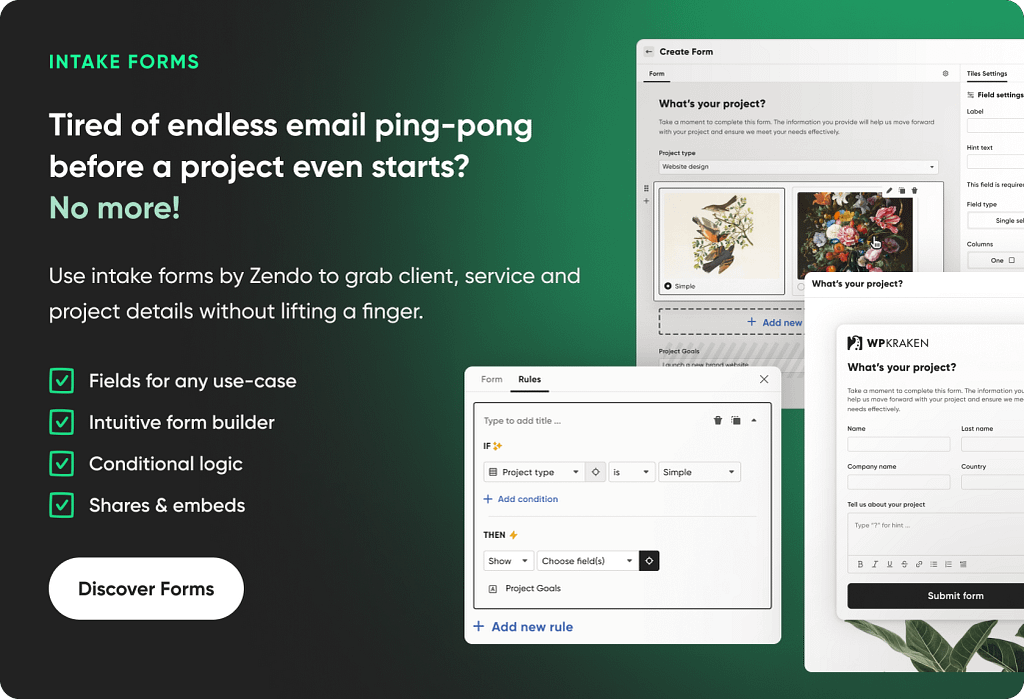
If you want to make sure you’re getting all the information at the start, intake forms are a must. Haven’t used intake forms yet? Zendo has an intake form builder that lets you create fully customizable forms to suit any agency, client, or project.
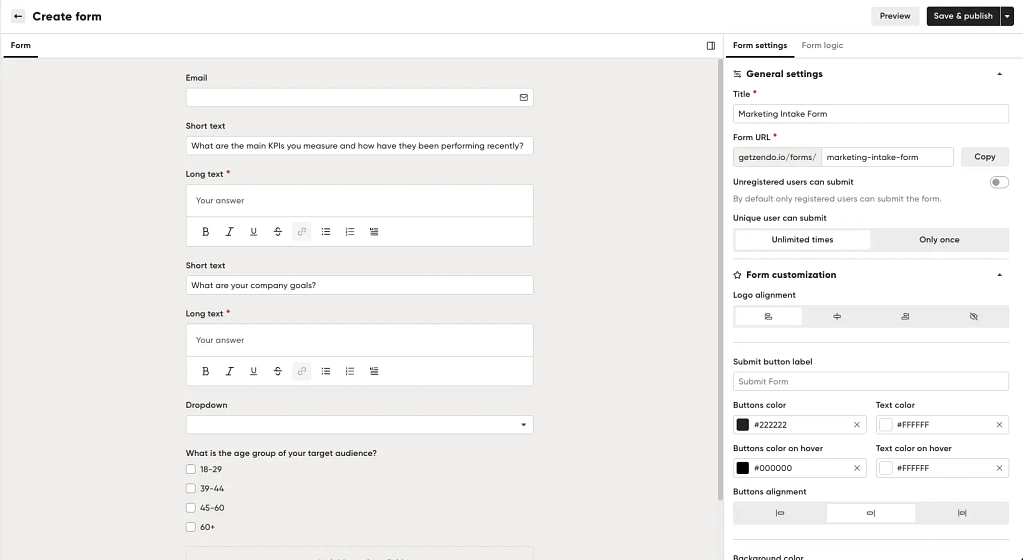
Build each section as you like, add 20+ fields, and change the colors, logos, and backgrounds to make it truly yours. Once you’re done making your intake form, embed it on your website or easily share it with the right clients.
3. Maintain Regular and Frequent Communication
For an agency, silence is the opposite of golden. Being proactive is what makes the agency-client relationship improve.
Frequent communication is a cornerstone of client retention. Schedule regular meetings to keep stakeholders informed of the latest developments, successes, and roadblocks.
Sometimes, even a well-timed check-in is a good idea. It can help you gauge the client’s temperature. However, don’t overdo those. It might be seen as counterproductive.
Speaking of roadblocks, make sure you communicate them clearly and early. That’s an indicator you’re working on solving the issues instead of using them as excuses when things have already gone wrong.
Yes, frequent meetings take a lot of time, especially when you have many clients. But lack of communication is one of the most common causes of churn. So think of it as a time investment that helps you prolong the partnership.
4. Make Progress Checking Easier for Your Clients
When clients don’t see the progress of your work regularly, they start wondering where their money goes. Aside from regular meetings, they should have quick and easy access to relevant data at any time.
Let’s say a stakeholder wants to check out the progress of the latest campaign. Sure, they can set up a meeting, look at your slide deck, and ask a bunch of questions. Or they could open up a client portal and see the status of the work in seconds.
In Zendo, the client portal allows your clients to perform a wide range of actions:
- Messaging,
- Orders,
- Sharing files,
- Approving quotes
- Processing payments.
The self-service aspect also makes the clients feel more empowered. Plus, easier access means they can be more proactive than with just email threads and scheduling meetings.
5. Showcase Results Regularly
Clients don’t hire agencies to receive deliverables. They hire agencies to achieve business outcomes.
Unfortunately, many agencies do great work but fail to communicate the impact of that work. As a result, clients may underestimate the value they’re receiving and start questioning whether the partnership is worth continuing.
Make it a habit to regularly connect your work to measurable results. Depending on your services, that could mean highlighting increases in traffic, leads, sales, conversions, engagement, customer retention, or other key performance indicators.
Regular reports are helpful, but numbers alone aren’t enough. Explain what the results mean and how they contribute to the client’s broader business objectives.
When clients clearly understand the return on their investment, price becomes less of a concern, and loyalty tends to increase. Agencies that consistently demonstrate value make it much harder for competitors to convince clients to switch providers.
6. Measure Their Satisfaction Often
A lot of agencies assume that if the clients aren’t complaining to the account manager, they must be satisfied. But that’s not always the case.
It’s another area where your proactivity can keep your clients happy for longer. Here’s what you should consider.
The right frequency makes all the difference: Asking for a rating and feedback every week will do more harm than good. The client will probably feel annoyed instead of open to feedback. But waiting for a whole quarter between surveys might be too long. Aim for a happy medium, like once a month, for example.
Your clients need a space to actually voice their opinions. Answering yes/no questions and giving ratings using stars or numbers looks good on paper and is easy to measure. But the real feedback happens when survey questions are open forums instead of checkboxes to fill out.
Asking open-ended questions will increase the chances of getting an honest and thorough response. It will also let you learn more than looking at pure numbers that have little context.
Make sure your surveys contain both short questions and open-ended opportunities for real feedback.
7. Respond Quickly to Client Feedback
While you can’t do anything about your clients taking a long time to reply, you can control your own responsiveness. Late responses are the first thing that will make clients feel underappreciated, and successful client management will avoid that at all costs.
One thing you can do is choose the right form of communication. Email may be the standard, but it doesn’t have the same sense of urgency as direct messages.
With the right management platform, you can combine real-time communication with work management or progress tracking.
That’s exactly how Zendo does it. Our all-in-one platform for agencies features collaboration and communication tools with the ability to manage work and share status updates with your clients at any time.
So not only are you more accessible to your clients, but you also have the context right at your fingertips. Every deliverable, status, and message in one place.
Conclusions
As you can see, there are many things you can do to reduce churn. Think of these strategies as an early warning system against losing clients.
Even though some of them might cost you a bit of time, they should be worth it in the long run.
What can get some of your time back is using the right platform to manage your clients. If you’re looking for a comprehensive solution for your agency, Zendo is the way to go.
Our platform supports your agency across the entire client lifespan. From onboarding to managing orders, showcasing statuses, communication, invoicing, and payments – Zendo makes all of them easier.
Don’t believe it? See for yourself during a free trial.
FAQ
What Is Considered a Healthy Churn Rate for Agencies?
A healthy churn rate for agencies is typically below 15–20% annually for retainer-based clients, although the ideal rate varies by industry and service model. Agencies with strong retention programs often keep clients for several years, resulting in lower churn and more predictable revenue.
Rather than focusing solely on industry benchmarks, agencies should monitor their own churn trends over time. If agency client churn is increasing, it may indicate problems with client satisfaction, communication, onboarding, or perceived value.
How Can Agencies Recover Relationships with Unhappy Clients?
Agencies can recover relationships with unhappy clients by addressing concerns quickly, communicating transparently, and taking clear action to solve the underlying problem. The sooner you respond to dissatisfaction, the greater your chances of preventing agency client churn.
Start by having an honest conversation to understand the client’s concerns, then create a specific plan to address them. Regular progress updates and follow-up meetings can help rebuild trust and demonstrate commitment. While not every client relationship can be saved, many clients are willing to stay when they feel heard, valued, and confident that their concerns are being taken seriously.
What Is The Impact of Pricing on Client Churn?
Pricing can contribute to client churn, but clients rarely leave because of price alone. In most cases, agency client churn occurs when clients believe they are not receiving enough value for what they pay.
Even premium-priced agencies can achieve strong retention when they consistently demonstrate results and return on investment.
To reduce price-related churn, agencies should set clear expectations, communicate outcomes regularly, and show how their work contributes to business goals. When clients clearly understand the value they receive, they are far less likely to switch providers based solely on cost.