
We all want to wow our clients, preferably from the get-go.
This means we might sometimes go way overboard with our promises, hyping the clients up beyond reason. Painting the dream of excellent results, such as better online visibility, improved conversion rates, or increased revenue, even.
But what we’re actually doing is setting ourselves up for a spectacular failure — unless you represent one of the very few businesses specializing in miracles.
Being honest and transparent, while not that attractive at first, is what will endear clients to you in the end. You say how it is, unafraid of calling bad ideas, careful with client’s money. A good business partner will sooner or later understand how valuable that is.
So how can you set realistic expectations without sounding like a downer? How can you maintain a professional image while explaining delays and solving miscommunication issues?
Let’s find out.
Why should you care about client expectations?
Client expectations ultimately decide the outcome of your business relationship.
If you deliver a great project, but it’s missing the features you promised due to time or budget limits, your client will be disappointed. They got a healthy egg, but they expected a whole chicken.
And if you deliver a perfectly average product — but fully aligned with client’s expectations — they’ll be happy enough to recommend you to their network and leave splendid reviews on social media. They got exactly what they wanted, even if it was ‘just okay’.
That’s the power of setting realistic expectations. And the art form is to make them sound exciting even if you’re not promising all that much.
What happens when your client faces a single instance of unsatisfactory customer experience? There’s a 50% chance they’ll switch to a competitor instead, so keep that in mind.
8 essential strategies for effective client expectations management
What are some proven strategies that most businesses can implement to manage, navigate, and strengthen client relationships?
1. Clear pricing
First of all — pricing. The most difficult topic to broach with clients, even though it’s the most important one. And for that reason alone, it’s great to start with it right off the bat.
Ideally, you should post your pricing on your website or on your social media page. If you don’t want to post the exact prices — or your work requires custom quotes — the next best thing is to post the price range.
💡 In Zendo, a Client Portal for service businesses, users can create a Storefront; a place you can use for clearly defining your offering, so that your clients can browse through it in their own time, without pressure.
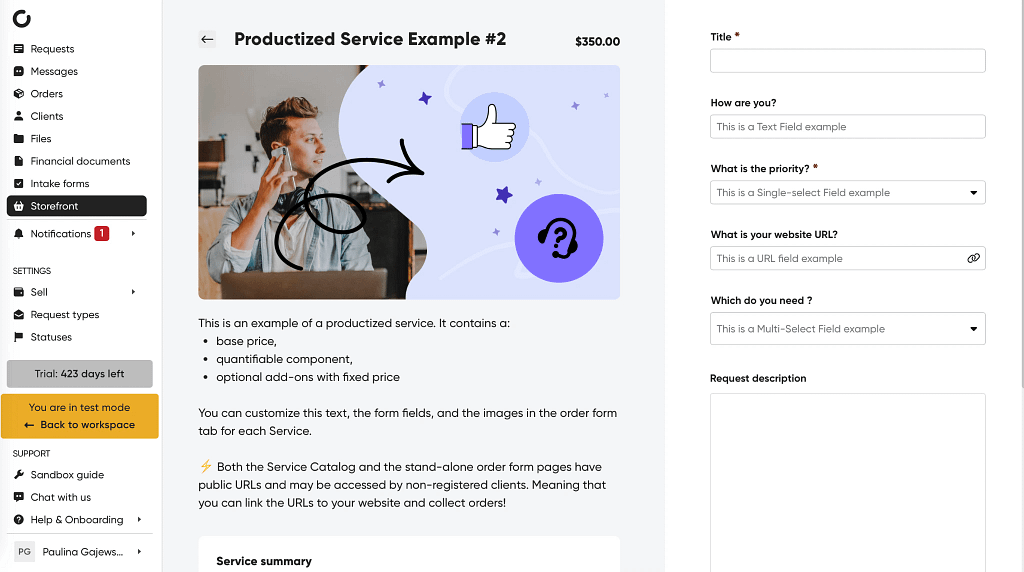
Zendo’s Storefront with an intake form
If for some reason that’s too much, include your pricing ranges in the proposal you sent, or in any other document that you share with potential clients.
Most importantly, be very clear about what your clients are paying for. That includes:
- Timeline for delivery and any deadlines,
- The exact deliverable (e.g., number of designs, pages, or products),
- File formats and resolution (e.g., JPG, PNG, PSD, AI, PDF, source files),
- Number of revisions or iterations,
- Licensing and usage rights (e.g., personal, commercial, exclusive, non-exclusive),
- Your general availability, including a time window for replies,
- Any ongoing support or maintenance.
This way, clients know exactly what they’re paying for and there are no surprises on either side. If someone demands you work more than you’re paid for, you can point out the relevant terms and conditions your clients have previously agreed to.
2. Smart proposal
The aforementioned proposal — a document that outlines the offering of a product or a service to a client — serves two reasons: managing expectations and emphasizing your unique selling point. It’s the most important document that clearly shows why you’re the right person for the job, so it must be persuasive and full of solid arguments.
Being transparent and straightforward can make you stand out from your competition. Make sure there’s no purple prose or walls of meaningless text that muddle the important parts. Using an aesthetically pleasing yet clear template also plays a significant role in readability — avoid decorative fonts, background images under text, or badly formatted columns.
For professionalism’s sake, ensure there are no grammar mistakes, all images — if any — are high-quality, and you speak about your business and your offering in the tone of voice that fits your brand.
If you want to step up your game, you can get inspired by HoneyBook’s Smart Files; there, you can combine your proposals with other documents, such as questionnaires or contracts. This way, if your client makes the decision to work with you, they can sign the contract immediately and then fill out the required form with the project’s details.
In Zendo, your clients can use the aforementioned Storefront to see what you offer and make their decision based on that.
3. In-depth questionnaire
By now, we’ve ensured your clients have a clear view of the long-term relationship that’s on the table. Now it’s time to make sure you understand their needs as well, if you want to better work together — after all, collaboration is a two-way street.
A robust survey or a questionnaire will help you gain such insight.
Their purpose is to help you understand:
- The goals your client wants to achieve and their success metrics,
- Key challenge or pain points they’re facing,
- Their brand (tone of voice, visuals, values),
- Target audience and key user segments,
- Existing assets, tools, or systems in use
- Competitors or benchmarks they look up to,
- Budget and financial constraints,
- Potential risks, constraints, or dependencies.
On top of it, you should also ask about their preferred communication style and frequency; do they want to use email for weekly updates, or would they like to be more involved, either on Slack or in their own password-protected Client Portal?
This will give you a thorough, in-depth look into your client’s wants, needs and expectations, leading to superior customer experience overall.
4. Thorough onboarding
In case your client has decided to work more closely with you, onboarding would be good to include.
The form of it may vary; it can be a PDF file listing all the spaces you will use (Slack channels, login credentials to tools like Figma or Miro, etc), it can be a video meeting where you lead your client through all the tools, or it can be an interactive checklist on the Client Portal’s dashboard.
A typical client onboarding should ideally include:
- Access to tools and platforms,
- Communication channels and key contacts,
- Project scope, deliverables, and timeline,
- Roles and responsibilities,
- Feedback and approval process,
- Meeting cadence and check-ins,
- Billing and payment terms.
💡 A smooth onboarding sets clear expectations and makes the collaboration much easier from day one. Moreover, according to Datuum, businesses that invest in onboarding processes can grow revenue by up to 5-10%.
5. Knowledge base
Another way of reiterating all the terms and conditions, as well as explaining the collaborative process end-to-end, is creating a simple knowledge base. Again, it can be a PDF file, or a password-protected, secure space. Whatever you choose, make sure the text is readable, all the information is categorized, and the language is clear and straightforward.
The important takeaway is to make the knowledge base accessible at all points. If you mention it once and never again, your client will simply forget about it. Including it in your email footer, in the Client’s Portal sidebar, linking to it in recurring updates, or shared documents helps keep it visible and actually used.
💡 In Zendo, you can customize clients’ dashboards, including sidebards. This way, you can ensure they have access to all the important files and spaces, such as Miro boards, YouTube videos, Google Sheets, Figma workspaces, and more.
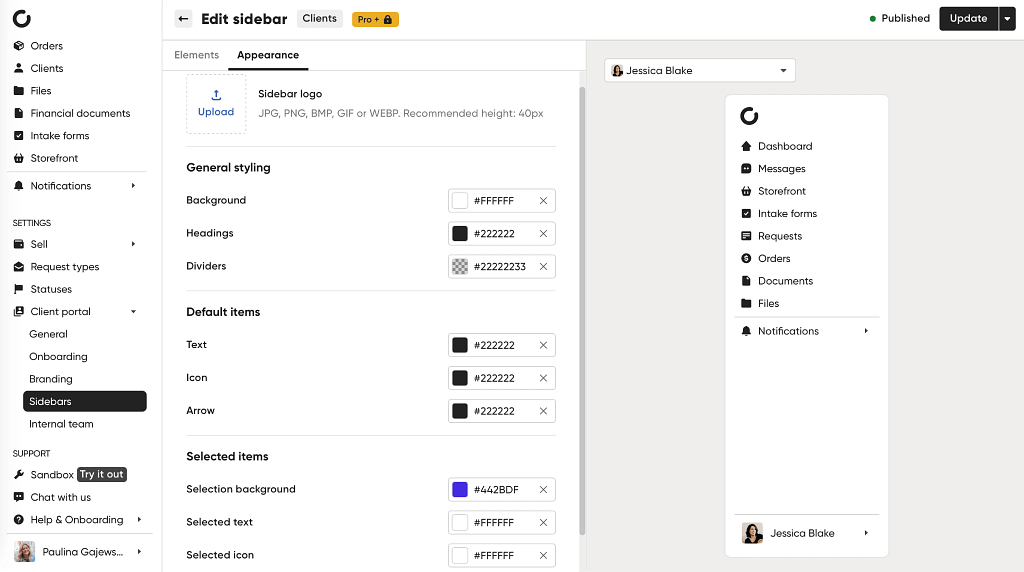
Sidebar customization options in Zendo
6. Underpromise & overdeliver
We’ve covered all the ways you can include all the important information across different sites, documents, and spaces. Now let’s talk about what you should say.
First of all — never overpromise.
It is tempting to promise the world to a great client, especially when the project itself seems exciting. Or to simply underestimate the risks, thinking nothing will go wrong, ever; no delays, no technical issues, no changes in the project scope. That’s why you should be cautious when it comes to discussing end results. It’s also smart to mention any risks early on, so that no one is caught unaware.
Does it seem like being a downer, dampening down a client’s excitement? A bit, but think of it this way: as a business partner, you’re supposed to be the voice of reason, knowing all the ins-and-outs of your profession. Your job is to say what’s a realistic deadline or why such an idea won’t work — and sooner or later, your clients will appreciate your transparency. And if you manage to exceed client expectations later, all the better for you!
7. Mention the next steps
Never leave your client unsure of what’s the next step.
Leaving a meeting? Say when you’ll meet again. Better yet, already schedule the next check-in.
Client sent feedback? While replying, say when you’ll send the next iteration — and keep your promise.
Client has approved the final version of your work? While sending deliverables, say what they can expect from you from now on: that you’ll keep the files stored for safe-keeping, that they can reach out to you in case of any issues, or that their next order will come with a discount.
In a way, always have the final word. Your clients should never be left wondering of what’s happening at any point of the client collaboration.
8. Reject bad apples
Unfortunately, not all clients are pleasant to work with. And no matter how well you try to shape their expectations, they’ll keep pushing the set boundary or even try to exploit you.
Even though it seems like a lost opportunity, it’s better to reject these clients outright (unless you’re in a tight spot!). What are the red flags you should be looking out for?
- Changing requirements all the time, seemingly on a whim,
- Expecting “just one more thing” outside the agreed scope,
- Unrealistic timelines or false urgency, expecting you to handle small issues in the middle of the night or during the weekend,
- Poor or inconsistent interaction, expecting immediate replies while they take their time with answering messages,
- Lack of clear decision-maker or too many stakeholders, muddling the communication,
- Negative talk about previous vendors or partners (unless they were really ripped off!).
In short, you should look out for any disrespect for your time, boundaries, or expertise; avoid these clients at all costs.
The nail in the coffin is delayed payments or hesitation around contracts. Asking for discounts right out of the gate is also a huge red flag — it means they’ll keep trying to exploit you throughout the whole business rapport.
What are common mistakes in managing client expectations?
Now that we’ve talked about what you should do, we should also mention what you shouldn’t do.
Breaking promises
Let’s start with the obvious — if you make a promise, keep it. If you supply your client with a thorough training on healthy communication through onboarding, knowledge base, and other resources, but then your actions won’t match your words, your clients might be disappointed at best, livid at worst.
And if your hand does slip, don’t bother your client with excuses. Frankly, they won’t care that your dog got sick or that your car broke down; keep it for your friend and family. Simply apologize and make sure to do better next time.
💡 According to Aspire CCS’s report, 20% of clients may consider changing providers after experiencing poor or unclear communication.
Setting unrealistic standards
In the similar vein, setting unrealistic standards makes it pretty difficult to keep your promises. If you juggle multiple projects at once, don’t inform your client that they can reach out to you day and night or that you’ll always reply within an hour. Make sure your rules for open communication are easy to follow through on both sides.
Curse of knowledge
When you’re a professional, especially with years of experience under your belt, it’s easy to forget that what’s obvious for your colleagues may not be obvious for your clients. After all, they may come to you with zero knowledge on the matter — that’s why they’re reaching out to you in the first place.
That’s why you shouldn’t assume you have the same baseline of knowledge. Make sure you’re on the same page in all matters and be as clear as possible about the end objective. This way, you’ll avoid misunderstandings that stem from different experiences and perspectives.
Using examples is a good way of checking if you’re on the right track.
Want vs. need
When showing, for example, specific project pieces, your client might be impressed enough to say “I want something like that!”. But you may know that what worked in one industry or business type may not work in another — it’s an important distinction to make.
Or, if your client gets stubborn about heavy animations on their website, slowing it down, you need to be able to articulate why that’s a bad idea. Or that their target audience — older generations, for example — won’t appreciate the clearly Gen Z sense of humor that’s making waves on TikTok.
Sometimes, clients get excited about the “fun” stuff. It’s your job to make sure they understand that fundamentals take priority, especially when you’re making products that need to be user-friendly, first and foremost.
No flexibility
Having healthy boundaries set in place on top of clear rules is great — but there should be some room for flexibility as well.
If you find a promising client who doesn’t show any red flags and politely asks for some leeway — such as evening meetings in consideration for different time zones or more iterations due to the project’s complex side — it’s good to accommodate them, as long as it doesn’t throw a wrench into your personal life.
Just make sure to mention it’s a special case, so that your client understands you’re making an exception just for them.
Scattered documentation
Last but not least, you need to remember all the agreements between you and the client for effective communication. But when you handle many clients, all with different projects and needs, relying on just your memory is a trap.
In that case, creating client records is a must. There, you can note down everything concerning each client, describing their preferences, uploading assets and files you’ve exchanged, and storing all the filled out forms. You wouldn’t want to waste precious time on manually searching for that one questionnaire on your Google Drive, after all — especially when it’s been a long time ago when you’ve uploaded that file.
💡 In Zendo, all the files and client data are stored automatically on the platform. And if you’d like to store them in another space as well as a form of backup, you can create an automated workflow with Zapier to do just that.
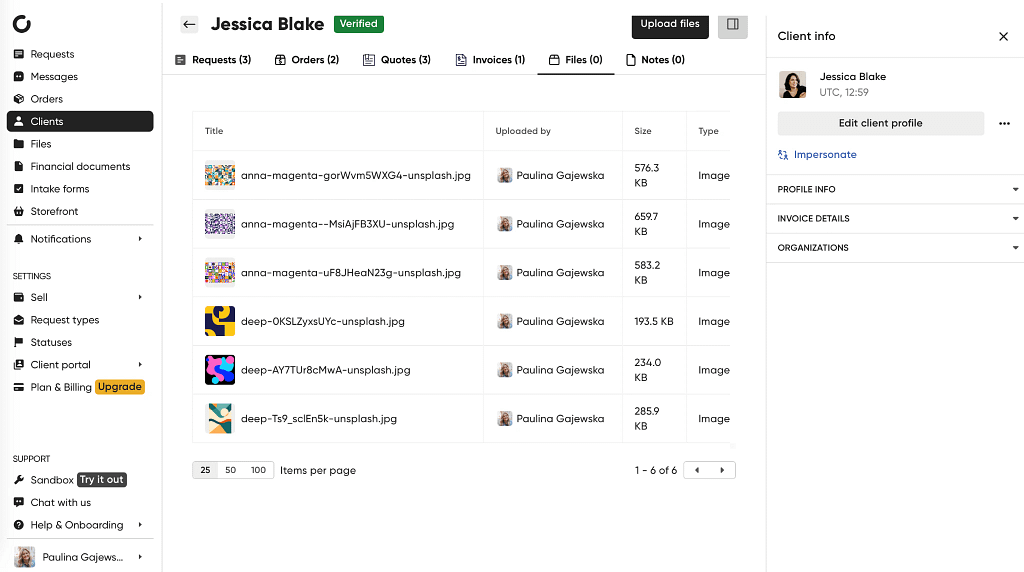
Client profile example in Zendo with uploaded files
Conclusions
Managing client expectations is essential for maintaining good business relationships. This way, no one will be surprised by the end results, sudden challenges in the middle of the project, or lack of replies in the middle of the night. Prioritize setting up boundaries that will help you reach a work-life balance and adapt as necessary to your client’s needs — sometimes, reaching a compromise is worth the hassle.
To make it even easier for yourself, you could consider using a Client Portal such as Zendo. With its help, you can set up a smooth onboarding, embed relevant pages and files on your client’s dashboard, create a detailed knowledge base, and make use of a real-time chat for better communication. Last but not least, trust the platform to save all the files in one place so that you never miss a thing!
Zendo comes with a forever free plan for one user so that you can test it out on your own terms and in your own time. Give it a try!
FAQ
What are the main client expectations?
Clients usually want clear and easy communication, honesty, and regular updates so they always know what’s happening. They appreciate realistic timelines, clear deliverables, and well-defined project boundaries to avoid confusion. Being responsive, flexible, and keeping them in the loop goes a long way. On top of that, they expect attention to detail, solid strategies that get results, and work that meets their expectations.
How to manage client expectations using software?
You can easily manage customer expectations with software by keeping communication, progress, and deliverables transparent. For example, Zendo lets you centralize client requests, documents, and updates in a single space so clients always know what’s happening. You can set clear statuses, timelines, and priorities for tasks, and clients can track progress in real time, reducing confusion or miscommunication.
What happens when client expectations are not aligned?
When client expectations aren’t aligned, projects can quickly run into confusion and frustration. Misunderstandings about deliverables, timelines, or priorities can lead to missed deadlines, repeated revisions, or work that doesn’t meet the client’s needs. Communication can break down, trust can erode, and both parties may feel dissatisfied. In the worst cases, it can harm the relationship, impact client satisfaction, and even affect long-term client loyalty or retention.
How do you set clear expectations at the start of a project?
To set clear expectations from the beginning, start by having a detailed conversation with the client about their goals, needs, and priorities. Define the project scope, deliverables, timeline, and any boundaries or limitations upfront, and document everything in writing. Be transparent about what’s realistic and what might be challenging, and outline how progress will be tracked and communicated. Agree on preferred communication channels, frequency of updates, and how feedback will be handled.
How do you handle unrealistic client expectations?
Start by listening carefully to understand their goals, then explain what’s feasible based on scope, resources, and timelines. Use clear examples, data, or past experience to show why certain expectations may not be practical, and offer alternatives or solutions that achieve similar outcomes. Establish transparent communication and document agreements to reduce the chance of any misunderstanding.
How do you rebuild trust after missing a deadline?
To build trust again, acknowledge the missed deadline honestly and avoid excuses. Communicate promptly with the client, explain what caused the delay, and share a clear plan for getting back on track. Offer realistic revised timelines and, if possible, ways to make up for the setback, like prioritizing critical deliverables. Keep updates frequent and transparent as you progress, and demonstrate consistent reliability moving forward.
How to improve client expectation management with Zendo?
Using a platform like Zendo can make managing client expectations a lot clearer and smoother by centralizing communication, service delivery, and progress visibility in one place. For example, clients can quickly look up their orders, requests, and documents, see the status of all the ongoing projects, and use the real-time chat to get in touch with the team whenever they need it.